
Rotator Cuff Tendinopathy: Causes, Symptoms, and Treatment
Rotator cuff tendinopathy is degenerative damage to one or more of the four rotator cuff tendons, most often the supraspinatus, caused by repeated loading and age-related wear rather than a single acute injury. That distinction matters for treatment: it is closer to a worn rope than an inflamed wound, which is why anti-inflammatory approaches alone rarely fix it. The primary recommended path is active rehabilitation, specifically progressive strength loading under a physical therapist’s guidance, and most people improve within weeks to a few months.
Right now, before you do anything else, here’s what to act on:
- Modify or temporarily reduce overhead lifting, throwing, or reaching motions that reproduce the ache.
- Use short-term icing and over-the-counter NSAIDs for flare-ups, not as a long-term plan.
- See a clinician promptly if you notice sudden, severe weakness or a real loss of motion. That combination can signal a full tear rather than tendinopathy.
Roughly 80% of people with partial rotator cuff tears improve functionally with a structured strengthening and mobility program. Surgery only enters the conversation after 6 to 12 months of consistent, well-run conservative care that hasn’t worked.
TL;DR:
- Most rotator cuff tendinopathy results from repetitive overuse and aging, not a single injury, making active strengthening the most effective treatment.
- About 80% of partial tears improve functionally with a structured, conservative rehab program lasting several months.
- Red flags like sudden severe weakness or motion loss indicate possible full tears requiring urgent evaluation and imaging.
- Repeated corticosteroid injections can weaken tendons over time and should be limited to short-term flare relief.
- Long-term shoulder health relies on ongoing maintenance, including gradual load management and continued scapular and rotator cuff exercises.
Table of Contents
- What Is Rotator Cuff Tendinopathy?
- Causes and Risk Factors Behind Shoulder Tendon Injury
- Recognizing the Symptoms of Rotator Cuff Issues
- Diagnosing Rotator Cuff Tendinopathy: Exams and Imaging
- Rotator Cuff Pain Treatment: Why Rehab Comes First
- Injections, PRP, and Other Nonoperative Options
- When Rotator Cuff Surgery Becomes the Right Option
- Rotator Cuff Exercises You Can Discuss With a Clinician
- How Long Rotator Cuff Rehabilitation Takes
- Preventing Rotator Cuff Injury Long Term
- How Thetxroom Approaches Conservative Shoulder Care
- Key Takeaways
- The Real Shift in How Shoulder Pain Gets Treated
- Sources
What Is Rotator Cuff Tendinopathy?
The rotator cuff is four muscles and their tendons working as a team to stabilize and rotate the shoulder joint. The supraspinatus lifts your arm out to the side and is the tendon injured most often. The infraspinatus and teres minor handle external rotation, the motion you use reaching behind your head. The subscapularis controls internal rotation and sits at the front of the shoulder, doing the quiet work of keeping the ball centered in the socket during every arm movement you make.
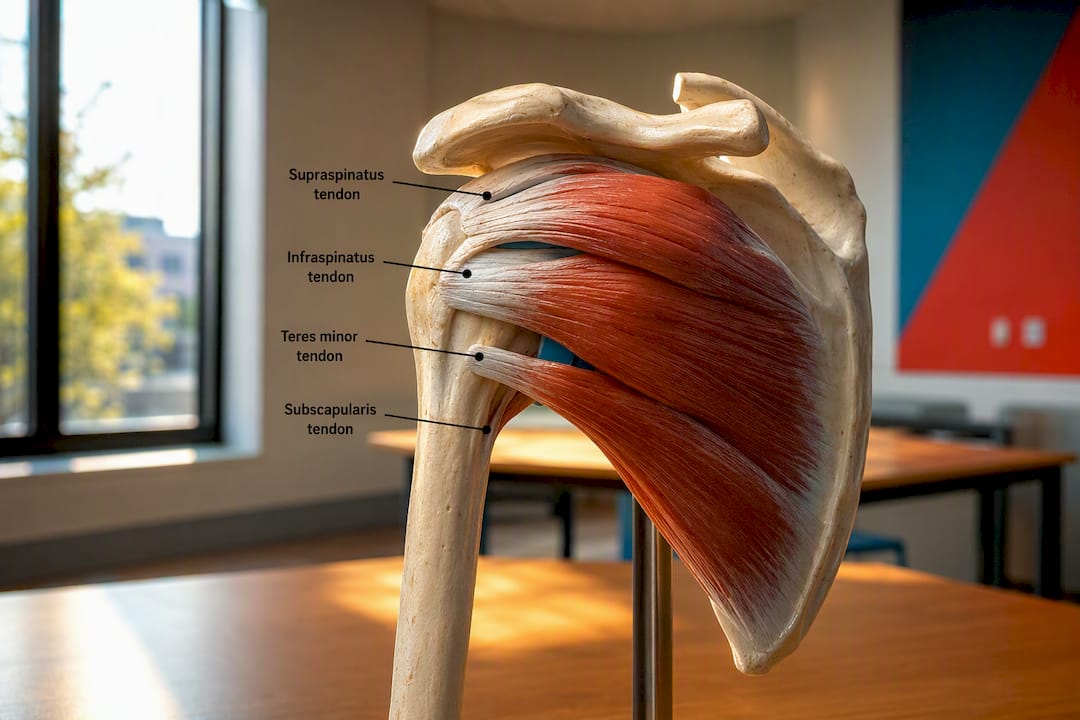
Here’s where terminology gets confusing, and clearing it up actually matters for how you think about treatment. “Tendinitis” implies active inflammation, like a sprained ankle mid swelling. But biopsies of chronically painful rotator cuff tendons rarely show inflammatory cells. What they show is tendinosis, disorganized collagen fibers, failed healing attempts, and small areas of tissue breakdown from repetitive strain that never got the chance to fully repair. “Tendinopathy” is the umbrella term clinicians now prefer because it doesn’t assume a cause.
This degeneration is strongly tied to age. Rotator cuff changes show up in 9.7% of shoulders in people 20 and younger, and climb to 62% in people 80 and older, a reflection of decades of cumulative loading and declining tendon blood supply rather than injury alone.
A few overlapping terms worth knowing:
- Bursitis refers to inflammation of the small fluid sac (the subacromial bursa) that cushions the tendon. It can coexist with tendinopathy and muddy the diagnostic picture.
- Impingement used to be the default explanation for rotator cuff pain, the idea that the tendon gets pinched under the acromion bone. Current guidelines treat this as an oversimplification.
- Partial tears are the natural next step if tendinopathy progresses untreated, a partial-thickness fraying of the tendon rather than a complete rupture.
Causes and Risk Factors Behind Shoulder Tendon Injury
Most rotator cuff tendinopathy comes from a mix of repetitive load and biological aging, not one dramatic event. Knowing which factors apply to you helps target rehab more precisely.
Overuse from repetitive overhead motion tops the list. Swimmers, baseball pitchers, volleyball players, and people whose jobs involve reaching overhead all day (painters, electricians, warehouse workers) load the supraspinatus tendon thousands of times a week. The tendon has a naturally poor blood supply near its attachment point, so it can’t keep pace with that repair demand.
Age-related degeneration compounds the mechanical wear. Tendon vascularity decreases over the decades, collagen becomes less elastic, and the cumulative microtrauma from a lifetime of arm use catches up. This is exactly why prevalence rates climb so sharply after age 60.
Posture and scapular mechanics play a bigger role than most people expect. A forward-rounded shoulder position changes the angle the rotator cuff tendons travel through during overhead motion, increasing friction and strain even during normal daily tasks like reaching for a top shelf.
Other contributing factors include:
- Smoking, which reduces tendon blood flow and slows healing capacity.
- Diabetes and other metabolic conditions linked to reduced tendon quality.
- A sudden spike in training volume or workload, sometimes called acute-on-chronic loading, where a tendon already weakened by chronic overuse gets pushed past its limit in one bad session.
Recognizing the Symptoms of Rotator Cuff Issues
The hallmark symptom is a dull, deep ache on the outer, upper arm, not sharp or localized like a pinch, but a persistent soreness that’s hard to point to with one finger. It commonly worsens at night, especially lying on the affected side, and tends to build gradually over weeks rather than appearing overnight.
Watch for this pattern:
- Shoulder pain with overhead press movements or any activity that raises the arm above shoulder height.
- Difficulty reaching behind your back, like fastening a bra or grabbing a wallet from a back pocket.
- A “painful arc”: pain that appears specifically between roughly 60 and 120 degrees of arm elevation and eases above and below that range.
- Noticeable weakness when lifting or rotating the arm, especially against resistance.
- Stiffness that limits how far you can reach, particularly first thing in the morning.
Most cases build slowly, and that gradual onset is itself a diagnostic clue distinguishing tendinopathy from an acute traumatic tear.
Red flags that warrant urgent evaluation rather than a wait-and-see approach: sudden, severe weakness that appears after a fall or forceful pull, a complete inability to hold the arm up against gravity, or an abrupt loss of motion following a specific traumatic event. Those signs point toward a possible full-thickness tear, a different injury requiring more immediate imaging and specialist input than degenerative tendinopathy typically needs.
Diagnosing Rotator Cuff Tendinopathy: Exams and Imaging
Diagnosis starts with a conversation, not a scan. A clinician who takes a careful history, when the pain started, what movements provoke it, whether there was a specific injury, what your job or sport demands of your shoulder, often has enough information to form a working diagnosis before touching your arm.
From there, several hands-on tests help narrow things down:
- Painful arc test. You raise your arm overhead and the clinician notes where in that range pain appears and disappears.
- Hawkins-Kennedy test. The clinician flexes your arm forward and internally rotates it to see if that position reproduces your pain.
- Empty-can (Jobe) test. You resist downward pressure with your arm out to the side and thumb pointed down, targeting the supraspinatus specifically.
- Resisted external rotation. Tests the infraspinatus and teres minor by having you rotate your forearm outward against resistance.
- Belly-press test. Checks subscapularis function by having you press your hand into your stomach while keeping the elbow forward.
- Drop arm test. If you can’t slowly lower your arm from an elevated position without it dropping, that suggests a more significant tear rather than isolated tendinopathy.
No single test is definitive on its own. Each one has real limits on sensitivity and specificity, meaning a positive result raises suspicion but doesn’t confirm a diagnosis, and a negative result doesn’t rule one out. Clinicians typically combine several tests with the symptom history to build confidence.
Imaging plays a supporting role, not a starting one. X-rays are useful mainly to rule out bone spurs, arthritis, or calcific deposits rather than to diagnose soft tissue tendinopathy directly. Ultrasound offers dynamic, real-time imaging at lower cost than MRI, letting a clinician watch the tendon move through a range of motion, though image quality depends heavily on the skill of whoever is holding the probe. MRI remains the standard when a tear is suspected and a surgeon needs detailed information on tear size, muscle atrophy, and retraction for planning purposes.
Pro Tip: Don’t push for an MRI at your first appointment just because it feels more thorough. The 2025 JOSPT clinical practice guideline specifically recommends against routine early imaging for tendinopathy, since findings like tendon thickening show up on scans of plenty of pain-free shoulders too. A clean rehab trial first often tells you more than a scan does.
Rotator Cuff Pain Treatment: Why Rehab Comes First
The evidence-based treatment for rotator cuff tendinopathy is progressive load rehabilitation, not rest, not immobilization, and not injections as a starting point. This represents a real shift from older impingement-focused thinking, which leaned heavily on the idea that decompressing the space around the tendon was the fix. Current clinical practice guidelines instead emphasize restoring muscle performance and scapular control through structured exercise, explicitly recommending against subacromial decompression surgery as a routine intervention.

Progressive loading works on a simple principle: tendons adapt and strengthen in response to gradually increasing mechanical stress, provided that stress stays within a tolerable pain range. Push too hard and you flare the tissue further. Do nothing and the tendon never rebuilds the capacity it lost. The sweet spot is loading that produces mild, manageable discomfort during exercise that settles within 24 hours.
A typical supervised program moves through phases:
- Isometric holds early on, contracting the muscle without moving the joint, which tends to reduce pain quickly and is a good starting point even in an irritable shoulder.
- Isotonic strengthening with light resistance bands or hand weights, moving the joint through a controlled range while building load tolerance.
- Scapular and motor-control work, retraining how the shoulder blade moves in coordination with the arm, since poor scapular timing often perpetuates the problem even after strength improves.
- Higher-load, functional strengthening that mimics the specific demands of your sport or job, whether that’s an overhead press pattern or a repetitive lifting motion at work.
Most programs run two to three sessions a week, sometimes with a therapist directly and sometimes as home exercises checked in on periodically, for a stretch of 8 to 12 weeks before reassessing progress.
Alongside the exercise program, short-term symptom control has a place: icing after activity, a brief course of NSAIDs during flare-ups, and modifying (not eliminating) aggravating movements. None of these replace the loading program; they just make it more tolerable while the tendon adapts.
The payoff is substantial. Roughly 80% of people with partial-thickness rotator cuff tears regain meaningful function through tailored strengthening and mobility work alone, without ever needing a procedure. That number alone should reframe how most people approach a new shoulder ache: as a rehab problem to solve methodically, not a structural problem requiring a fix from outside.
Pro Tip: Track your pain on a simple 0 to 10 scale during and after each session. If loading exercises consistently push you above a 5, or if pain lingers more than a day afterward, that’s a sign to scale back the resistance, not push through it. This kind of pain-monitoring is a core piece of how physical therapists dose your program.
For a real-world example of how progressive conservative treatment gets structured for a related joint problem, see how hip labral tear conservative treatment is staged, since the underlying loading logic carries over well to shoulder tendon rehab.
Injections, PRP, and Other Nonoperative Options
Corticosteroid injections deliver real short-term relief for a painful flare, but they come with a catch worth understanding before agreeing to one. Research indicates repeated steroid injections can weaken tendon tissue over time and may even complicate outcomes if surgery is eventually needed. Most clinicians now limit these injections to occasional, targeted use, usually to calm a flare enough to tolerate the rehab exercises that actually build lasting improvement, rather than as a repeated management strategy.
Platelet-rich plasma (PRP) injections use a concentrate of your own blood platelets to try to stimulate tendon healing. The evidence here is mixed. Some patients report benefit, but results vary enough across studies that it’s reasonable to view PRP as investigational rather than a proven fix, and it’s worth having a direct conversation with your provider about realistic expectations before pursuing it.
Extracorporeal shockwave therapy delivers acoustic pulses to the tendon to encourage a healing response, and percutaneous tenotomy is a minimally invasive needle procedure that disrupts degenerated tissue to trigger repair. Both are alternative options with variable evidence, better suited to cases that haven’t responded to a solid rehab trial.
A specialist referral makes sense when pain and weakness persist despite several weeks of a well-run loading program, or when a clinician suspects a tear that imaging needs to characterize before deciding on next steps.
When Rotator Cuff Surgery Becomes the Right Option
Surgery is a fallback, not a first move. The clearest indication is persistent, functionally limiting pain or weakness after 6 to 12 months of genuinely consistent nonsurgical care that hasn’t produced adequate improvement. Acute, full-thickness tears in younger or highly active patients are the other main category, since these tears typically don’t heal well on their own and delaying repair can lead to muscle retraction that makes later surgery harder.
Two main surgical approaches exist:
- Arthroscopic repair, done through small incisions with a camera, is the more common approach today and generally involves a shorter recovery than open surgery.
- Open repair, reserved for larger or more complex tears where arthroscopic access isn’t sufficient.
Surgery reattaches torn tendon to bone and cleans up damaged tissue, but it doesn’t replace the rehab work. Recovery typically starts with a period of immobilization in a sling, followed by a graduated physical therapy program that mirrors many of the same phases used in nonsurgical rehab, isometrics, then active range of motion, then progressive strengthening, usually stretching over four to six months before a return to full activity.
Rotator Cuff Exercises You Can Discuss With a Clinician
Rehab exercises should always be introduced gradually and ideally reviewed by a physical therapist who can adjust them to your specific presentation, but a few reliable staples show up in most programs.
- Pendulum swings. Lean forward, let the affected arm hang, and gently swing it in small circles. This is a low-load way to encourage motion without active muscle effort, useful in the earliest, most irritable phase.
- Towel stretch and finger-walk. Using a towel behind your back to gently improve internal rotation range, or walking your fingers up a wall to build overhead reach without loading the tendon aggressively.
- Cross-body stretch. Pulling the affected arm across your chest with the opposite hand to stretch the posterior shoulder capsule.
- Isometric holds against a wall or doorframe in multiple directions, a good entry point for building tolerance before adding resistance.
- Resistance band rotations, external and internal, progressing weight and repetitions as symptoms allow.
- Scapular squeezes and wall slides to rebuild the coordination between shoulder blade and arm movement that often breaks down with chronic pain.
These specific movements, including the pendulum, towel stretch, and cross-body stretch, are commonly recommended starting points for home-based rotator cuff rehabilitation.
The general progression rule: increase reps before you increase resistance, and increase resistance before you increase range or speed. If a specific exercise consistently spikes pain above a tolerable level or the pain lingers into the next day, that’s your signal to dial it back and check in with a physical therapist rather than pushing through.
Pro Tip: Pair your strengthening routine with a related resource on shoulder blade pain relief exercises, since scapular control problems and rotator cuff tendinopathy often travel together and respond to overlapping corrective work.
How Long Rotator Cuff Rehabilitation Takes
Most people notice meaningful improvement within four to eight weeks of starting a consistent, well-dosed loading program, though full resolution of chronic tendinopathy commonly takes several months. The 6 to 12 month mark isn’t an arbitrary number; it’s the window guidelines use before conservative care is considered to have had a fair trial, and only then does surgical consultation typically enter the conversation for cases that haven’t responded.
Two things shape that timeline more than most people expect. First, age matters mechanically: rotator cuff changes become more common with each decade, meaning older patients are managing a tendon with less inherent reparative capacity, even when treatment is followed diligently. Second, and less obvious, is the psychological piece. Patients who go into rehab believing it won’t work tend to have worse outcomes and are more likely to end up considering surgery, a pattern that underscores why buying into the process, and giving it a genuine 8 to 12 week trial before judging results, matters as much as any single exercise choice.
- Weeks 1 to 4: pain reduction and early motion work.
- Weeks 4 to 12: progressive strengthening and functional loading.
- Months 3 to 12: continued building toward full return to sport, lifting, or occupational demands, with surgical opinion reserved for those not progressing.
Preventing Rotator Cuff Injury Long Term
Once symptoms settle, the goal shifts to keeping them from coming back, and that means treating shoulder health as ongoing maintenance rather than a problem you solve once and forget.
Start with your workspace and training setup. Adjust desk and monitor height so you’re not reaching or working with elevated arms for hours at a stretch, and if your job or sport involves repetitive overhead motion, build in deliberate load management, spreading volume across the week instead of cramming it into one heavy session.
Keep a light version of your rehab strengthening program running indefinitely, even after pain resolves. Two short sessions a week of scapular and rotator cuff strength work is a reasonable maintenance dose for most people. If you’re returning to a demanding sport or heavy lifting after a layoff, ramp volume up gradually over several weeks rather than jumping back to your previous training load immediately. Athletes and tactical populations in particular benefit from structured injury prevention habits built around progressive load management, a principle that applies just as directly to shoulder tendon health as it does to lower-body durability.
How Thetxroom Approaches Conservative Shoulder Care
At Thetxroom in Plano, Texas, shoulder tendinopathy gets treated as a whole-system problem, not an isolated sore spot. The clinic’s core approach, the Fascial Distortion Model (FDM), is a hands-on manual therapy method that addresses restrictions in the connective tissue surrounding the rotator cuff, working alongside, not instead of, the progressive exercise loading that guidelines recommend.
A typical patient path looks like this:
- A thorough intake assessment identifying which movements provoke pain and where mechanical restrictions sit.
- Hands-on FDM therapy sessions aimed at restoring tissue mobility and reducing the guarding that often accompanies chronic tendon pain.
- A staged rehab plan that builds strength and motion progressively, tailored to whether you’re recovering for daily life or trying to get back to a specific sport.
Combining direct manual therapy with a structured loading progression reflects exactly the kind of comprehensive rehab model that current clinical guidelines point toward, treating the whole shoulder system rather than chasing a single inflamed spot.
Pro Tip: If your shoulder pain has lingered more than a few weeks despite rest and home stretching, that’s usually the point where a hands-on evaluation, rather than more waiting, makes the biggest difference.
For readers dealing with a related but distinct tendon issue, Thetxroom’s page on tendinitis versus tendinopathy breaks down how the clinic differentiates and treats each. If shoulder pain is your primary concern right now, the clinic’s shoulder pain treatment page outlines what a first visit for this specific condition looks like, and it’s the most direct next step if you’re ready to move past self-management and get a hands-on assessment.
Key Takeaways
| Point | Details |
|---|---|
| Know the real diagnosis | Tendinopathy is degeneration (tendinosis), not classic inflammation, so anti-inflammatory-only approaches rarely resolve it alone. |
| Rehab is first-line care | Progressive loading and scapular strengthening resolve most cases within weeks to a few months. |
| Give conservative care time | Guidelines call for 6 to 12 months of consistent rehab before surgery enters the conversation. |
| Limit steroid injections | Corticosteroids ease flares short-term but repeated use can weaken tendon tissue over time. |
| Watch for red flags | Sudden severe weakness or abrupt loss of motion warrants prompt evaluation for a possible tear. |
The Real Shift in How Shoulder Pain Gets Treated
The old impingement story, that shoulder pain comes from a tendon getting pinched under a bone spur, made surgery sound like the logical fix. It’s been quietly losing ground for years, and the 2025 guideline update makes the newer thinking explicit: this is mostly a loading and muscle-performance problem, and the fix is teaching the tendon to tolerate stress again.
Where conventional advice still falls short is patience. Plenty of people quit a rehab program at three or four weeks because it “isn’t working,” when the honest timeline runs closer to two or three months. That mismatch between expectation and biology probably sends more people toward premature injections or surgical consults than any actual treatment failure does.
If you take one thing from this guide, let it be this: find a clinician who will assess your specific movement pattern rather than hand you a generic exercise sheet, and commit to that plan for a real stretch of time before judging it. The tendon adapts on its own schedule, not yours.
— Chris
This article is general information, not a substitute for advice from a qualified doctor. Consult a qualified healthcare professional about your own circumstances before acting on anything here.
Sources
- Rotator Cuff Pain: Tendonitis, Tendinosis and Tendinopathy | HSS
- Rotator Cuff Tear: Symptoms & Treatment | Cleveland Clinic
- Rotator cuff injury: Symptoms & causes | Mayo Clinic
- What to do about rotator cuff tendonitis | Harvard Health