
Hip Labral Tear Conservative Treatment: A Stepwise Plan
A supervised conservative pathway, built around physical therapy, activity and load modification, and targeted pain control, often reduces symptoms enough to delay or avoid hip labral surgery entirely. That’s not wishful thinking. It’s the working model behind major health-system guidance and the 2025 multidisciplinary consensus statement that now shapes how surgeons, physical therapists, and physicians approach these tears together.
Here’s what that pathway typically includes:
- Physical therapy focused on mobility, motor control, and progressive strengthening
- Activity modification to reduce painful hip impingement during daily movement and sport
- Pain management with NSAIDs, acetaminophen, or short-term injections when needed
- Manual and adjunct therapies to reduce guarding and improve rehab quality
- Assistive devices like a cane, used temporarily to unload the joint
Most clinicians recommend a structured trial of several months before revisiting the surgical conversation. Age, the extent of joint degeneration, and whether mechanical symptoms are mild or severe all shift that timeline. If your pain responds to activity changes and you don’t have significant catching or locking, the smartest first move is starting a targeted PT program and getting your care team coordinated early, rather than waiting to see if things resolve on their own.
Key Takeaways
Conservative treatment, built around physical therapy, activity modification, and targeted pain control, can meaningfully reduce hip labral tear symptoms and delay or prevent surgery for many patients within a 3 to 6 month structured trial.
| Point | Details |
|---|---|
| Start with PT, not surgery | Physical therapy addresses motor control and strengthening, the mechanics most often behind labral pain. |
| Commit to a real timeline | Give a structured rehab program 3 to 6 months before reconsidering surgical options. |
| Watch for red flags | Progressive locking, instability, or worsening imaging findings signal it’s time for a specialist opinion. |
| Sequence pain control before load | Calm inflammation first with medication or a brief injection, then prioritize motor control before heavy strength work. |
| Coordinate hands-on and active care | Thetxroom pairs Fascial Distortion Model therapy with staged rehab and PT coordination to support conservative recovery in Plano. |
Table of Contents
- Who Is a Good Candidate for Conservative Hip Labral Treatment?
- How Is a Hip Labral Tear Diagnosed Before Starting Treatment?
- The Core Conservative Treatments for Hip Labral Tears
- What Does a Physical Therapy Program for a Labral Tear Look Like?
- Can Manual Therapy Help With a Labral Tear?
- Do Injections Help With Hip Labral Tears?
- How Long Does It Take to Improve With Conservative Treatment?
- When Should You Reassess or Seek Urgent Care?
- What Does the Research Say About Conservative Hip Labral Care?
- Setting Realistic Expectations for Conservative Hip Care
- How Thetxroom Approaches Conservative Hip Care in Plano
- Frequently Asked Questions
- Sources
Who Is a Good Candidate for Conservative Hip Labral Treatment?
Not every torn labrum behaves the same way, and not every patient should default to physical therapy before anything else. Certain clinical features make a strong case for trying non-surgical hip treatment first, while others suggest the clock is already ticking toward a surgical consult.
You’re likely a good fit for a conservative-first approach if:
- Your pain responds noticeably when you change how you move, sit, or train
- Mechanical catching, if present, is mild and not getting worse week to week
- Imaging shows limited or no significant osteoarthritis in the joint
- You’re willing to commit to a structured rehab program for several months
- Your goals are functional (walking, working, moderate activity) rather than elite-level cutting sports
On the other side, certain findings should push you toward an earlier specialist opinion rather than a long rehab trial:
- Repeated episodes of the hip feeling like it’s giving way or subluxating
- Severe, persistent mechanical locking that doesn’t ease with rest or PT
- Imaging showing progressive joint space narrowing or advancing arthritis
- High-demand athletes needing rapid return to deep hip flexion, pivoting, or cutting
Age and activity level matter here too. A competitive soccer player with a labral tear and joint instability has a very different risk calculus than someone in their fifties managing intermittent groin discomfort. The 2025 consensus statement found that 76% of expert recommendations reached strong or unanimous agreement on one point in particular: candidate selection works best when a full team, including surgeons, physicians, physical therapists, and athletic trainers, weighs in together rather than one provider making the call in isolation.
Pro Tip: If you’re unsure which category you fall into, don’t guess. Bring your imaging and a clear symptom timeline to a physical therapist or sports medicine physician who can screen you against these criteria in a single visit, before you spend months on a rehab plan that might not fit your case.
How Is a Hip Labral Tear Diagnosed Before Starting Treatment?
Diagnosis isn’t just about confirming a tear exists. It’s about figuring out whether that tear is actually the source of your pain, because labral tears show up on imaging in plenty of people who have no symptoms at all.
Clinicians typically start with a physical exam using a handful of provocative maneuvers:
- FADIR test (flexion, adduction, internal rotation), which reproduces anterior pinching in many labral tears
- FABER test (flexion, abduction, external rotation), useful for distinguishing hip joint pain from lower back or sacroiliac sources
- Log roll test, which isolates the hip joint capsule itself
- Resisted straight leg raise, which can flag intra-articular irritation
Imaging comes next, but it plays a supporting role rather than a deciding one. Standard X-rays check for bony shape abnormalities like femoroacetabular impingement and rule out arthritis. An MRI, or more often an MR arthrogram (where contrast dye is injected into the joint before scanning), gives a clearer picture of labral tissue. Neither test alone confirms that the labrum is what’s causing your pain. Plenty of people walk around with labral tears visible on MRI and zero symptoms.
When the exam and imaging don’t agree, a diagnostic intra-articular injection, usually numbing medication injected directly into the joint under imaging guidance, helps confirm whether the hip joint itself is the pain generator. If your symptoms disappear temporarily after the injection, that’s a strong signal the joint is involved rather than the lower back, pelvis, or surrounding soft tissue.
Pro Tip: Always correlate what the exam shows with what the images show before agreeing to any procedure. Treating a picture instead of a person is one of the most common ways patients end up in surgery they didn’t need.
The Core Conservative Treatments for Hip Labral Tears
Conservative hip labral injury recovery isn’t one treatment. It’s several tools used in sequence, each doing a different job. Some manage pain. Others actually change the mechanics that caused the tear to become symptomatic in the first place. Knowing which is which helps you understand why your plan looks the way it does.
Physical therapy as the central pillar
Physical therapy does the heavy lifting in almost every conservative protocol, and for good reason — following a mobility restoration checklist for athletes helps ensure a safe, progressive rehab process. The hip joint depends on roughly 30 muscles for stability and movement, according to guidance from Children’s Hospital of Philadelphia, and a labral tear often coincides with poor motor control among that muscle group rather than pure structural failure. A well-designed program restores mobility where it’s limited, rebuilds motor control where it’s sloppy, and progressively loads the hip so it tolerates daily activity and sport again. This isn’t just strengthening for strength’s sake. It’s retraining the joint to move without pinching.
Activity and load modification
This is the part patients underestimate the most. Small mechanical adjustments can take real pressure off an irritated labrum:
- Reducing squat depth to avoid the point where the femoral head jams into the front of the socket
- Shortening stride length during running to limit hip flexion under load
- Adjusting sitting posture and standing up more frequently to counter prolonged hip flexion
- Temporarily lowering training volume in sports that involve repeated pivoting or deep flexion
Prolonged sitting deserves specific mention here. Hours of hip-flexor overload from sitting can produce anterolateral hip discomfort that mimics, or actively worsens, labral symptoms, which is one reason Children’s Hospital of Philadelphia points to ergonomic changes as a necessary companion to exercise, not an afterthought.
Pain management tools
Over-the-counter NSAIDs (ibuprofen, naproxen) or acetaminophen can take the edge off enough to participate in rehab, and topical anti-inflammatory gels offer a lower-risk option for people who can’t tolerate oral NSAIDs regularly. Corticosteroid injections sometimes serve as a short-term bridge, calming inflammation enough that a patient can finally do the strengthening work that was too painful before. Orthobiologic options like hyaluronic acid or platelet-rich plasma exist, but the evidence supporting them for labral tears specifically remains limited and mixed. Nobody should expect these to replace the rehab work.
Assistive devices and gait aids
A cane or a single crutch, used for a short period, can unload the joint enough to calm an acute flare and let early-phase rehab proceed without constant pain reinforcement. This isn’t a long-term solution. It’s a temporary bridge while motor control and strength catch up.
Statistic Callout: The 2025 consensus statement found 76% strong or unanimous agreement among experts that labral tear management works best as a team effort, not a single-provider decision, reinforcing why PT, medical management, and specialist oversight typically run in parallel rather than in isolation.
Here’s the honest breakdown: medications, injections, and gait aids control symptoms. They buy you comfort and time. Physical therapy and load management change mechanics, which is what actually determines whether your hip functions better six months from now.
Pro Tip: Sequence matters more than most patients realize. Get pain under control first, then prioritize motor control before you chase heavy loads. Jumping straight to aggressive strengthening while the joint is still irritated tends to reproduce the exact pinching that caused the problem, according to expert clinical-reasoning guidance on labral tear management.
What Does a Physical Therapy Program for a Labral Tear Look Like?
A good PT program for a hip labral tear isn’t a fixed list of exercises. It’s a progression, and jumping ahead too fast is one of the most common reasons rehab stalls out.
Phase 1 (weeks 0 to 4): Symptom control and safe mobility. The goal here is calming irritation and restoring pain-free range of motion without provoking anterior pinching. Expect gentle mobility drills, submaximal isometric holds for hip stability, and basic glute activation work like bridges and clamshells.

Phase 2 (weeks 3 to 8): Activation and basic strength. Once mobility feels safer, the focus shifts to building genuine strength in the muscles that control the femoral head’s position, particularly the glutes and deep hip rotators. Single-leg loading drills and core bracing work typically enter here.
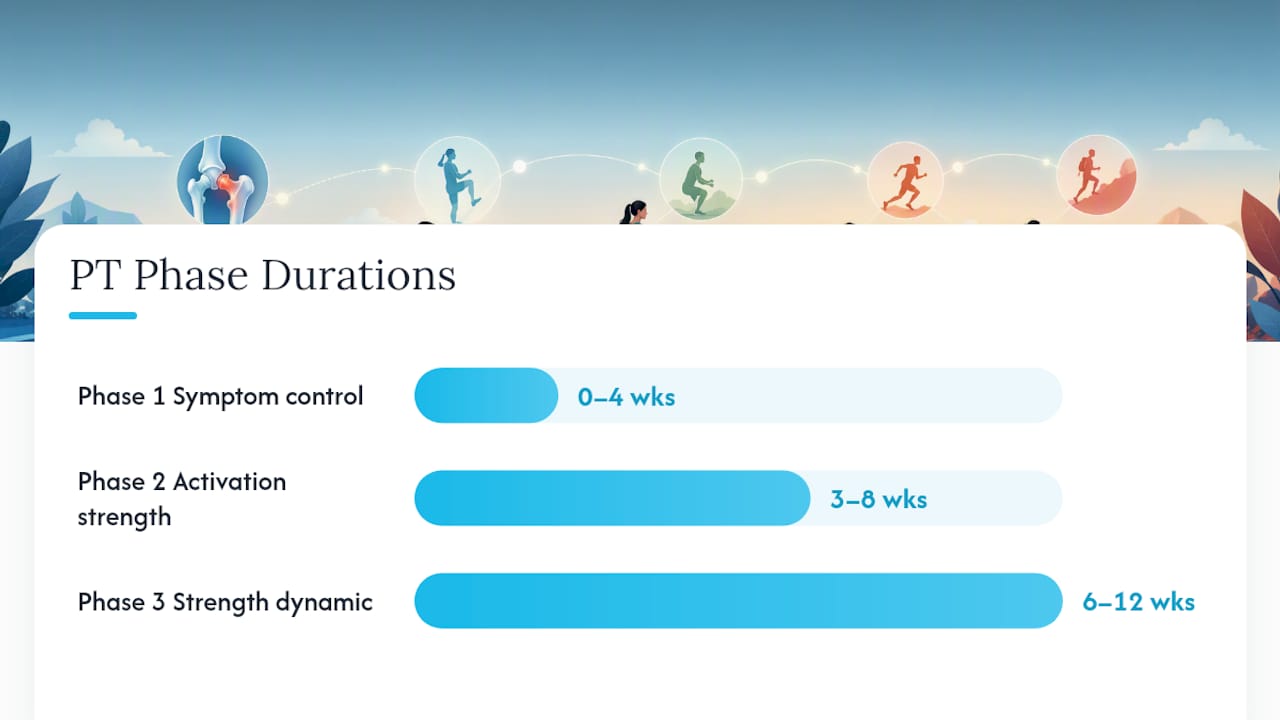
Phase 3 (weeks 6 to 12): Progressive strength and dynamic control. This phase introduces heavier resistance, lateral hip control drills, and controlled impact preparation like step-downs and light hopping, always monitored for reproduction of catching or sharp pain.
Phase 4 (weeks 10 and beyond): Sport or job-specific preparation. The final stretch mirrors the actual demands of your activity, whether that’s returning to running, squatting under load at work, or cutting on a soccer field.
A sample early-phase week might include:
- Daily gentle hip mobility work that stays well short of painful ranges, following graded hip-opening movements that avoid anterior pinching
- Three sessions of isometric hip holds and glute bridges
- Short walking sessions, monitoring for any increase in catching afterward
- One rest or active-recovery day focused purely on breathing and gentle stretching
By mid-phase, measurable goals should include pain-free single-leg stance for 30 seconds and glute bridge sets without compensation. By late phase, most patients are working toward symptom-free squatting to a functional depth and controlled single-leg landing mechanics.
Not all soreness is a red flag. General muscle fatigue the day after training is expected. Sharp joint pain, new catching, or a locking sensation that wasn’t there before means you regress the program, not push through it.
Pro Tip: Chase movement quality before you chase load. If pain is running high, start with submaximal isometrics held for 20 to 30 seconds rather than dynamic exercises. Motor control that’s pain-free beats heavy reps that reproduce pinching every time.
Can Manual Therapy Help With a Labral Tear?
Hands-on treatment isn’t a replacement for exercise-based rehab, but it earns a real place alongside it. Manual therapy techniques, including soft-tissue work and joint mobilization, typically aim at short-term symptom relief, improved mobility, and reduced muscle guarding so the active rehab that follows actually works better.
Picture a typical session: soft-tissue work loosens overactive hip flexors and surrounding musculature, joint mobilization improves capsular mobility, and then the patient moves immediately into activation drills like glute bridges or single-leg balance work while the joint feels looser and less guarded. That combination often produces better same-day results than either approach alone.
Timing is where people get this wrong. Manual therapy works best as an enabler, not a substitute. Scheduling hands-on sessions early in a rehab block, before the harder strengthening work, tends to reduce pain enough that patients can execute higher-quality movement during that same visit. Approaches built on the Fascial Distortion Model follow exactly this logic: address soft-tissue restrictions first, then load the joint while it’s primed to move well. Clinics offering range-of-motion focused care often build sessions around this same sequence.
Pro Tip: If you’re combining manual therapy with a PT program, ask your provider to schedule the hands-on session on the same day as your harder strength work, ideally beforehand. It maximizes the window where your joint moves best.
Do Injections Help With Hip Labral Tears?
Injections play a supporting role in conservative care, not a starring one. Three types come up most often:
- Diagnostic anesthetic injection: numbing medication injected into the joint to confirm whether the hip itself is generating the pain
- Corticosteroid injection: reduces inflammation short-term, sometimes enough to make rehab tolerable when pain was previously blocking progress
- Hyaluronic acid or platelet-rich plasma (PRP): orthobiologic options with mixed and limited evidence specific to labral tears
Injections tend to help in two clear scenarios: clarifying the actual source of pain when the exam and imaging don’t line up, or acting as a temporary bridge when inflammation is severe enough to prevent meaningful participation in exercise. A diagnostic injection followed by targeted PT is a common and sensible sequence. So is a corticosteroid injection used specifically to unlock a few weeks of higher-quality strengthening work that pain had been blocking.
What injections aren’t is a routine add-on for everyone. Current consensus guidance doesn’t endorse orthobiologics like PRP as standard care, largely because the supporting data remains low-certainty and inconsistent across studies. If a provider suggests PRP or hyaluronic acid as a first-line option before you’ve tried structured PT and load management, that’s worth a second opinion.
How Long Does It Take to Improve With Conservative Treatment?
Recovery timelines vary, but a general pattern shows up across clinical outcome studies. Small clinical series tracking hip function scores like the iHOT-12 have reported clinically meaningful improvements over months of structured rehab, though sample sizes in these studies tend to be small, so treat the numbers as directional rather than a guarantee.
Here’s roughly what to expect at each checkpoint:
- 6 weeks: Reduced pain during daily activities, improved tolerance for basic movements like sitting and light walking, early gains in hip mobility.
- 3 months: Noticeable strength improvement, better control during single-leg activities, and for many patients, a return to modified versions of their normal activity.
- 6 months: Functional improvement plateaus for most people who are going to respond well, with many returning to close to full activity, though some residual awareness of the hip during high-demand movements is common.
If you’re not seeing meaningful progress by the three-month mark, that’s not automatically a failure. It’s a signal to reassess. A clear checklist for when to pursue a surgical opinion includes:
- Persistent severe mechanical symptoms (locking, giving way) that haven’t budged
- A well-run rehab program of 3 to 6 months that hasn’t produced meaningful functional gains
- Imaging showing progressive joint damage since your initial workup
- Inability to meet basic functional goals needed for work or daily life
Prognosis depends heavily on individual factors: age, how much cartilage damage exists alongside the labral tear, how long you’ve had symptoms before starting treatment, and whether you’ve already tried and failed a prior rehab attempt. It’s worth being clear-eyed about what each path actually offers. Surgery physically repairs the torn tissue. Conservative care doesn’t fix the structure on an MRI, but according to Cleveland Clinic, it frequently delivers enough functional improvement that surgery becomes unnecessary for many patients.
When Should You Reassess or Seek Urgent Care?
Certain symptoms shouldn’t wait for your next scheduled follow-up. Watch for:
- Progressive mechanical locking that’s getting worse, not staying stable
- New or worsening episodes of hip instability or the joint giving way
- Rapidly increasing pain or visible swelling
- Fever, chills, or other signs suggesting infection
- New numbness, tingling, or weakness in the leg
Outside of those red flags, a reasonable follow-up cadence looks like an early PT check-in at 4 to 8 weeks to confirm the program is on track, a more formal outcome review around 12 weeks to measure functional progress, and a full multidisciplinary or surgical reassessment at the 3 to 6 month mark if things have plateaued. If any red flag symptom shows up before those checkpoints, don’t wait. Earlier imaging or a specialist referral is the right move.
What Does the Research Say About Conservative Hip Labral Care?
The evidence base for hip labral injury recovery through conservative means is stronger than many patients assume, though it’s not uniform across every treatment option.
- A 2025 multidisciplinary consensus statement found 76% strong or unanimous agreement that team-based care, involving surgeons, physicians, PTs, and trainers together, produces better candidate selection and outcomes than isolated decision-making.
- A 2018 case-series and treatment-continuum paper described staged conservative management producing meaningful functional gains through structured PT and clinical reasoning.
- Cleveland Clinic and Johns Hopkins Medicine both list nonsurgical treatment, rest, activity modification, medication, and PT, as the recommended starting point for many patients before surgery is considered.
- Children’s Hospital of Philadelphia frames physical therapy as a vital intervention capable of eliminating the need for surgery in some cases, while also noting that pre-surgical PT improves outcomes when an operation does become necessary.
Not every piece of this puzzle carries equal weight. Diagnostic pathways and the value of multidisciplinary coordination have strong consensus behind them. Orthobiologic injections and long-term comparative effectiveness data between conservative and surgical paths remain thin and mixed.
Expert consensus supports conservative management as an appropriate first-line pathway for many patients with labral tears, with team-based care improving candidate selection, while reserving surgery for cases with clear failure of nonoperative treatment or progressive structural damage.
Setting Realistic Expectations for Conservative Hip Care
Conservative care works best when patients understand what it’s actually trying to accomplish. It’s not aiming to make your MRI look different in six months. It’s aiming to get you moving, working, and living without the joint dictating your day. That distinction shapes how Thetxroom approaches soft-tissue and joint mobility work using the Fascial Distortion Model, always paired with progressive rehab rather than offered as a standalone fix.
If you’re chasing structural “healing” as your success metric, you’ll likely be disappointed even when your function improves substantially. Judge progress by what you can actually do: sitting through a workday, walking without guarding, returning to the activities that matter to you. Those functional markers, not imaging, are what most consensus guidance treats as the real measure of success.
How Thetxroom Approaches Conservative Hip Care in Plano
If you’re dealing with hip pain and weighing your options, you’re not choosing between doing nothing and jumping straight to surgery. Thetxroom works the middle ground that most people never realize exists: hands-on Fascial Distortion Model therapy paired with a coordinated rehab plan, built specifically around what your hip needs at this stage of recovery.
A first visit typically starts with an assessment of how your hip moves, where it guards, and which activities reproduce your symptoms, information that shapes a staged plan rather than a generic exercise handout. When it makes sense, Thetxroom coordinates directly with local physical therapists or sports medicine providers so your care doesn’t happen in silos. This mirrors the same team-based logic that related joint conditions and disc-related injuries already lean on for conservative, non-surgical recovery.
Not everyone avoids surgery. But a meaningful number of patients see real functional improvement without ever needing it. If your hip pain has been limiting how you sit, work, or train, book an assessment with Thetxroom and find out what a tailored, hands-on conservative plan looks like for your specific case.
Frequently Asked Questions
Can a hip labral tear heal without surgery?
The torn tissue itself typically doesn’t structurally repair without surgery, but conservative treatment can reduce pain and restore function well enough that many people never need an operation. Cleveland Clinic frames this as symptom management and functional improvement rather than structural healing.
How long should I try physical therapy before considering surgery?
Most consensus guidance points to a structured trial of 3 to 6 months of well-run rehabilitation before revisiting surgical options, with earlier reassessment if red-flag symptoms appear.
What exercises should I avoid with a labral tear?
Avoid deep squatting, aggressive hip flexion under load, and any movement that reproduces sharp anterior pinching or catching, especially early in rehab before motor control has improved.
Is walking okay with a hip labral tear?
Walking is generally fine and often encouraged, though shortening your stride and avoiding uneven or high-impact surfaces early on can reduce irritation while your rehab program progresses.
Do I need an MRI to start conservative treatment?
Not necessarily. Many clinicians begin conservative care based on clinical exam findings alone, reserving MRI or MR arthrogram for cases where diagnosis is unclear or symptoms don’t respond to initial treatment.
Sources
- PubMed: multidisciplinary consensus statement (2025)
- CONSERVATIVE TREATMENT CONTINUUM FOR MANAGING FEMOROACETABULAR IMPINGEMENT SYNDROME AND ACETABULAR LABRAL TEARS IN SURGICAL CANDIDATES – PMC
- Hip Labral Tear: Symptoms & Treatment — Cleveland Clinic
- Non-Surgical Hip Treatment — Children’s Hospital of Philadelphia