
Anterior Pelvic Tilt: Fix Your Posture and Reduce Pain
Anterior pelvic tilt (APT) is when the front of your pelvis drops forward and the back rises, exaggerating the curve in your lower spine. If you suspect you have it, here is where to start: do a quick side-view self-check in a mirror, try a hip-flexor stretch and a glute bridge today, and watch for any red flags (leg weakness, numbness, or bladder changes) that signal you need a clinician rather than a YouTube routine. Most cases are functional, meaning tight and weak muscles are the driver, and they respond well to consistent exercise. Persistent or worsening pain is a different story and deserves a professional assessment.
Table of Contents
- What is anterior pelvic tilt, and why does it matter?
- How to tell if you have anterior pelvic tilt
- What causes anterior pelvic tilt, and which muscles are involved?
- What symptoms does anterior pelvic tilt cause?
- Exercises and stretches to correct anterior pelvic tilt
- When should you see a professional?
- How hands-on clinics approach APT treatment
- How long does it take to correct anterior pelvic tilt?
- Daily habits and ergonomics that reduce anterior pelvic tilt
- Key Takeaways
- The part most online guides get wrong
- Thetxroom can help you move past the plateau
- Useful sources
What is anterior pelvic tilt, and why does it matter?
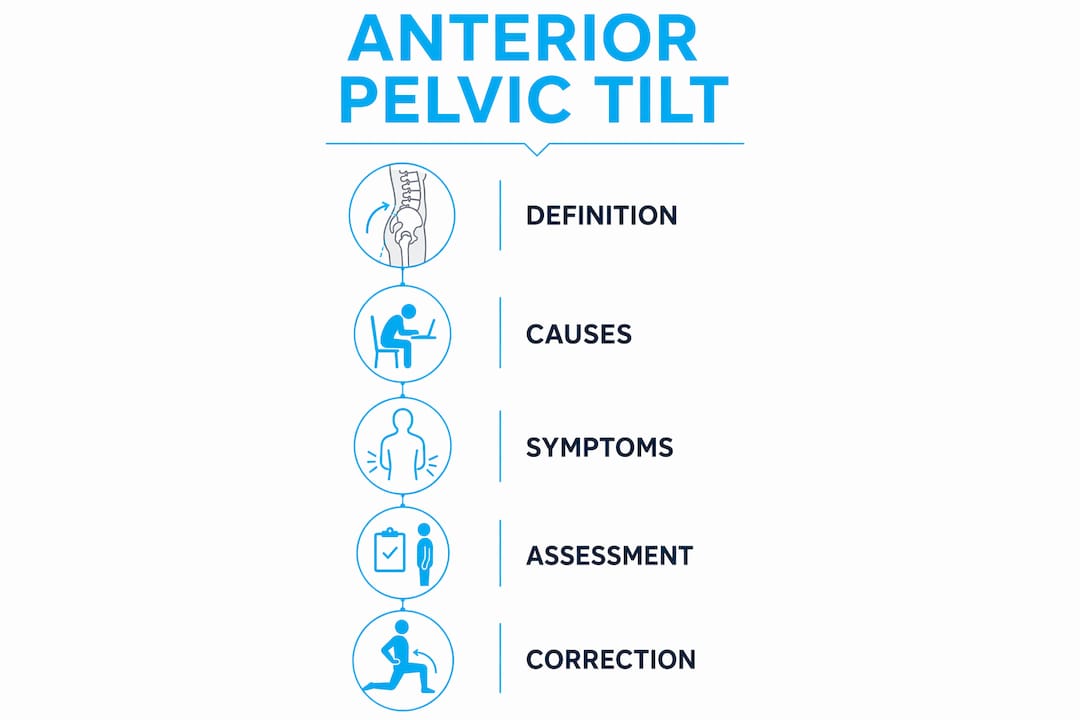
The pelvis rotates in the sagittal plane, the front-to-back plane you see from the side. When the anterior superior iliac spine (ASIS, the bony points at the front of your hip) drops lower than the posterior superior iliac spine (PSIS, the dimples at the back), the pelvis has tilted forward. That rotation pulls the lumbar spine into a deeper arch, increasing lumbar lordosis and shifting load onto the facet joints and posterior discs.
A neutral pelvis sits roughly level. Some forward tilt is completely normal: Physiopedia reports average anterior tilt angles around 13.0 ± 4.9°. The clinical concern starts when the tilt is excessive and symptomatic, not when it simply exists.
Key distinctions worth knowing:
- Neutral pelvis: ASIS and PSIS roughly level; lumbar curve moderate and comfortable
- Mild APT: slight forward tip, often asymptomatic and not clinically significant
- Excessive APT: pronounced forward drop, visible lumbar arch, and often associated with pain or movement limits
- Structural vs. functional: structural tilt comes from bony anatomy; functional tilt comes from muscle imbalance and responds to rehab
Mild anterior pelvic tilt is often asymptomatic. The goal of treatment is not a cosmetically perfect pelvis but a pelvis that moves well and does not hurt.
How to tell if you have anterior pelvic tilt
You do not need a goniometer to get a reasonable read on your pelvic position. These low-tech checks give you useful information in about five minutes.
Side-view mirror check
Stand naturally in front of a full-length mirror turned sideways. Look for:
- Buttocks that protrude noticeably behind you
- A visible deep arch in the lower back (you could slide a fist through the gap between your back and a wall)
- A belly that presses forward even when you are not overweight
Take a photo from the side with your phone at hip height for a cleaner look. A plumb line from your ear should pass through your shoulder, hip, and ankle. If your hips are well in front of that line, forward tilt is likely.
Hands-on landmark check
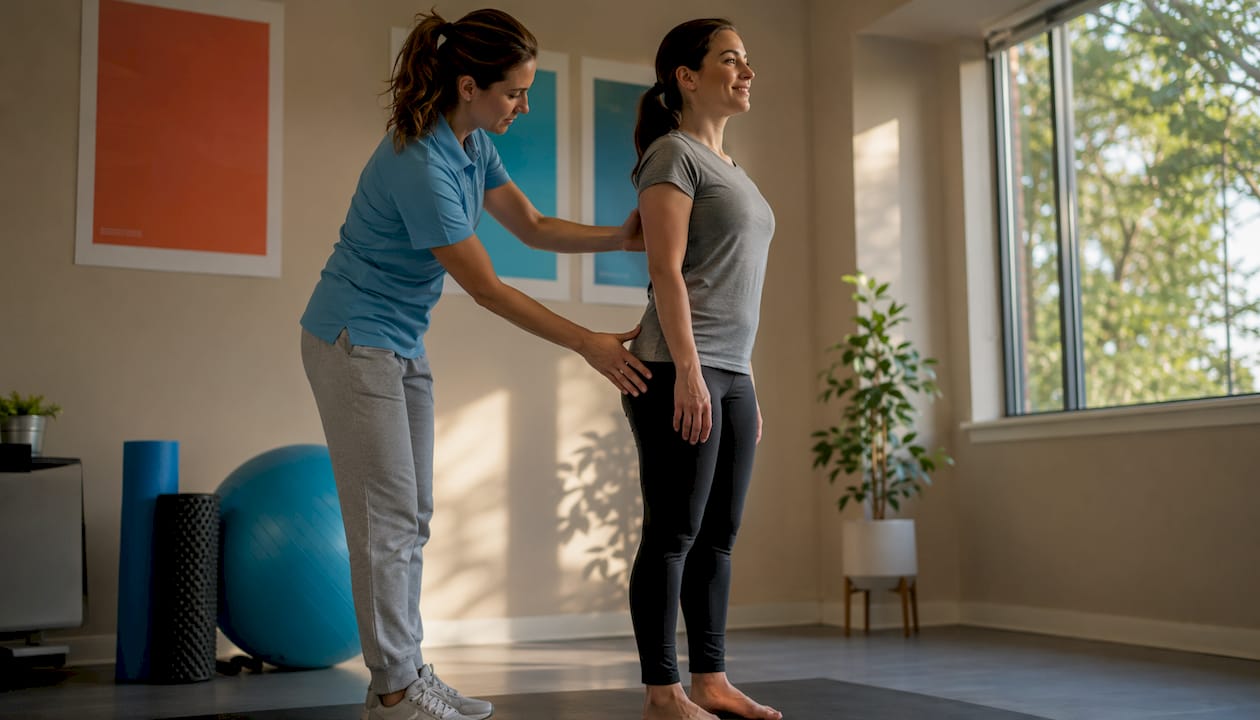
Place your thumbs on your ASIS (the front hip points) and your fingers on your PSIS (the dimples above your tailbone). If your thumbs sit noticeably lower than your fingers, your pelvis is tipping forward.
Simple movement tests
- Supine pelvic tilt: Lie on your back with knees bent. Flatten your lower back against the floor by tightening your abs. If there is a large gap between your back and the floor before you engage, that is a sign of habitual anterior tilt.
- Thomas test cue: Lie on a table edge and pull one knee to your chest. If the other thigh rises off the table, hip-flexor tightness is present, a common driver of APT.
- Single-leg stance: Stand on one leg for 10 seconds. Excessive forward lean or hip drop suggests glute weakness contributing to pelvic instability.
Pro Tip: Take your side-view photo after a full day of sitting, not first thing in the morning. Postural patterns are most pronounced when your muscles are fatigued from holding you up all day.
Red flags that need a clinician now
- Sudden severe low-back pain with no clear cause
- Leg weakness, numbness, or tingling that does not resolve
- Bowel or bladder changes
- Pain that wakes you from sleep or worsens lying down
- Progressive neurological symptoms
Any of these override home exercise. See a clinician before doing anything else.
What causes anterior pelvic tilt, and which muscles are involved?
The most common driver is prolonged sitting. When you sit for hours, your hip flexors shorten adaptively, your glutes switch off, and your abdominals stop doing their share of stabilizing the pelvis. Over time, the pelvis settles into the tilted position as a default.
Common causes:
- Prolonged sitting (office work, commuting, gaming)
- Sedentary lifestyle with little hip-extension activity
- Sport-specific postures (cycling, rowing, heavy squatting without posterior chain balance)
- High-heeled footwear, which shifts the body’s center of mass forward
- Genetic or structural variation in hip socket depth or lumbar curvature
Muscles that are typically tight:
- Iliopsoas and rectus femoris (hip flexors): pull the front of the pelvis down
- Lumbar extensors (erector spinae): pull the back of the pelvis up, deepening the arch
Muscles that are typically weak:
- Gluteus maximus and medius: the primary posterior pelvic stabilizers
- Hamstrings: assist in pulling the pelvis back toward neutral
- Abdominals (especially lower fibers of the transverse abdominis): resist the forward pull from the hip flexors
This pattern has a name: lower crossed syndrome. Tight hip flexors and lumbar extensors cross with weak abdominals and glutes, creating a predictable imbalance that perpetuates the tilt. It commonly co-occurs with upper crossed syndrome, where tight chest and neck muscles pair with weak deep neck flexors and lower trapezius, producing forward head posture and rounded shoulders. Addressing only the hips while ignoring the rest of the kinetic chain is one reason many people plateau.
Accurate clinical assessment distinguishes functional tilt (muscle and fascial imbalance) from structural tilt (bony anatomy). That distinction matters for choosing the right intervention.
What symptoms does anterior pelvic tilt cause?
The most common complaint is a dull, persistent ache in the lower back, particularly after long periods of sitting or standing. Hip flexor tightness often shows up as a pulling sensation at the front of the hip or thigh, especially when walking uphill or climbing stairs.
Other symptoms people frequently report:
- A visible “belly pooch” even with low body fat (the forward pelvic tilt pushes the lower abdomen forward)
- Prominent buttocks that stick out regardless of muscle development
- Reduced hip extension during walking, which shortens stride length
- Hip discomfort or pinching at the front of the joint during squatting or sitting cross-legged
How APT affects movement:
- Squatting: excessive forward lean or butt-wink at the bottom often traces back to limited hip mobility from tight flexors
- Running: reduced glute activation shortens push-off and increases hamstring load
- Lifting: a tilted pelvis under load shifts stress toward the posterior disc and facet joints
APT is not inherently dangerous. Many people have measurable forward tilt and no symptoms at all. The clinical concern arises when it correlates with lower back pain, hip impingement, or movement dysfunction that limits daily activity. The belly pooch question comes up constantly: yes, restoring pelvic position can reduce its appearance, but that is a side effect of better mechanics, not the goal.
Exercises and stretches to correct anterior pelvic tilt
Stretching tight hip flexors alone produces short-lived results. The pelvis returns to its tilted position unless you also build the glute and core strength to hold it there. The program below pairs both.
Starter exercise toolkit
-
Half-kneeling hip-flexor stretch
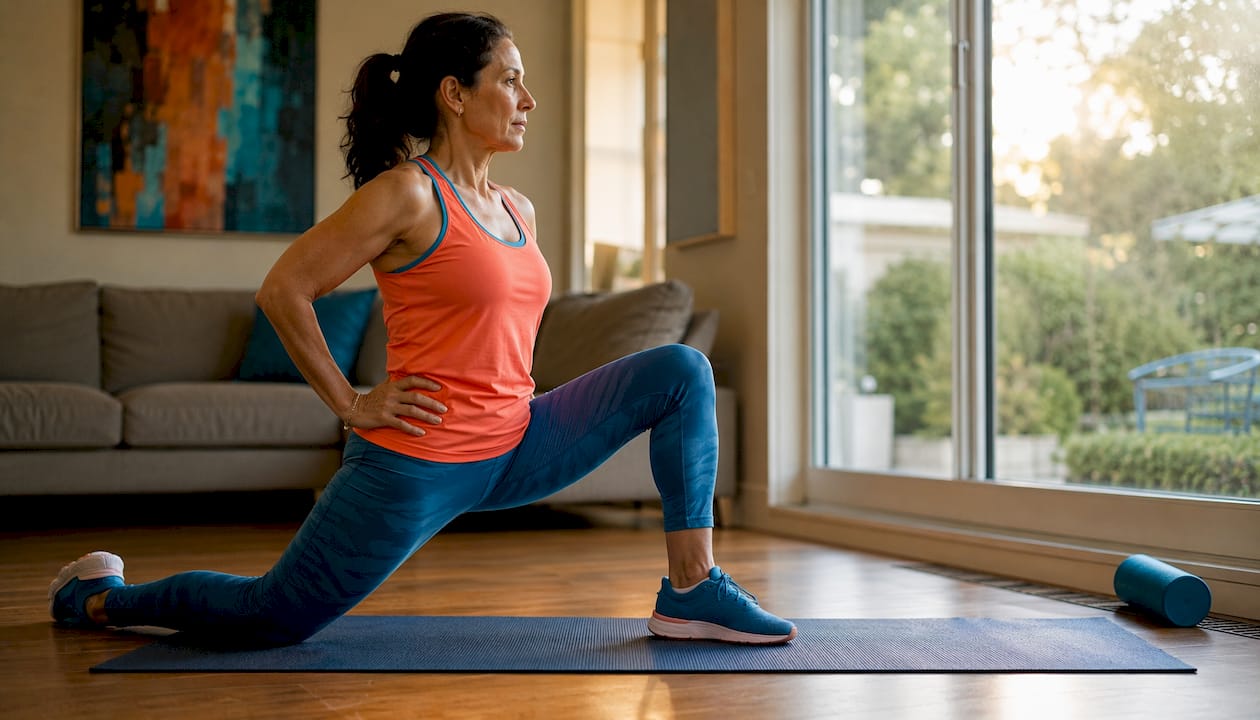
Kneel on one knee (the side being stretched), other foot forward. Tuck your tailbone under slightly by squeezing the glute of the kneeling leg. Shift your hips forward until you feel a stretch at the front of the kneeling hip. Hold 30–45 seconds. Switch sides.
Sets/reps: 2–3 sets per side, daily.
Common mistake: arching the lower back to get more range. Keep the pelvis tucked. -
Glute bridge
Lie on your back, knees bent, feet flat. Drive through your heels to lift your hips until your body forms a straight line from knees to shoulders. Squeeze your glutes at the top for 2 seconds. Lower slowly.
Sets/reps: 3 sets of 12–15 reps. Progress to single-leg bridges when 15 reps feel easy.
Common mistake: using the lower back to push up. The glutes do the work. -
Posterior pelvic tilt drill
Lie on your back, knees bent. Gently flatten your lower back against the floor by contracting your abs, as if you are pulling your belt buckle toward your ribs. Hold 5 seconds, release.
Sets/reps: 2 sets of 10–12 reps. Use this as a warm-up cue before any exercise. -
Dead bug (core stability)
Lie on your back, arms pointing to the ceiling, hips and knees at 90°. Maintain your lower back flat against the floor. Slowly lower one arm overhead while extending the opposite leg toward the floor. Return and switch.
Sets/reps: 3 sets of 6–8 per side. Progress by slowing the tempo or adding a light dumbbell.
Common mistake: letting the lower back arch as the limbs extend. Stop the range of motion before that happens. -
Supine hamstring stretch
Lie on your back. Loop a strap or towel around one foot and straighten the leg toward the ceiling until you feel a gentle pull in the back of the thigh. Hold 30 seconds per side.
Sets/reps: 2 sets per side, post-workout or evening. -
Standing quad stretch
Stand near a wall for balance. Bend one knee and hold the ankle behind you, keeping your knees together and your pelvis tucked (do not let the lower back arch). Hold 30 seconds.
Sets/reps: 2 sets per side. -
Plank (core endurance)
Forearms on the floor, body in a straight line from head to heels. Brace your abs and squeeze your glutes. Do not let your hips sag or pike.
Sets/reps: 3 sets of 20–30 seconds. Progress to 45–60 seconds as endurance builds.
Pro Tip: Before any exercise, cue yourself to find a neutral pelvis first: imagine your pelvis is a bowl of water and you are trying not to spill it forward. That mental image recruits the right muscles before you even move.
Frequency and progression:
- Do the stretches daily (morning or evening, or both)
- Do the strengthening exercises 3–4 days per week
- After 4–6 weeks of consistent work, progress glute bridges to single-leg, add resistance to the dead bug, and introduce hip-thrust variations
Safety note: Stop any exercise that produces sharp pain, joint pinching, or radiating leg symptoms. Mild muscle fatigue is expected; pain is not. Pairing stretching with progressive strengthening is what produces lasting change.
When should you see a professional?
Home exercise works for many people with functional APT. But there are clear thresholds where professional assessment is the smarter move.
Book an appointment if:
- Pain has lasted more than 4–6 weeks despite consistent home exercise
- Symptoms are worsening rather than plateauing or improving
- You have any of the red-flag neurological signs listed earlier
- You are unsure whether your tilt is functional or structural
- Movement restrictions are affecting your work, sport, or daily activities
What each clinician offers:
- Physical therapist (PT): movement analysis, corrective exercise programming, manual therapy, and functional retraining. The most common first stop for APT.
- Chiropractor: spinal and pelvic joint manipulation, soft-tissue work, and postural assessment. Particularly useful when joint mobility is restricted alongside muscle imbalance.
- Orthopedic MD or spine specialist: imaging, ruling out structural pathology (disc herniation, hip impingement, spondylolisthesis), and surgical referral if needed. Usually the third step, not the first.
What to bring to your first visit:
- A brief symptom diary (when it hurts, what makes it better or worse, how long it has been present)
- A side-view photo of your posture if you have one
- Your exercise history and any activities you have already tried
Clinicians commonly use palpation and movement testing to classify your tilt, along with the Thomas test, inclinometer measurements, and single-leg stance assessment. That classification drives the treatment plan.
How hands-on clinics approach APT treatment
Exercise alone addresses the muscle imbalance, but it does not always resolve the fascial and soft-tissue tension that keeps the pelvis locked in a tilted position. That is where manual therapy adds real value.
At clinics like Thetxroom, the approach typically follows this sequence:
- Assessment: palpation of ASIS/PSIS landmarks, movement screening, Thomas test, and single-leg stance to classify the tilt and identify the dominant muscle imbalances
- Hands-on fascial work: the Fascial Distortion Model (FDM) addresses specific fascial distortions in the hip flexors, lumbar fascia, and thoracolumbar junction that resist pelvic repositioning
- Soft-tissue myotherapy: targeted work on the iliopsoas, rectus femoris, and lumbar extensors to reduce resting tone before activation exercises
- Targeted activation: glute and core activation drills performed immediately after manual work, when the tissue is most receptive
- Progressive rehab: a home program that advances over weeks, with check-ins to adjust load and technique
Small intervention studies have reported angle reductions and symptom improvements with combined approaches. The systematic review evidence notes reductions of 1.7°–5.8° in anterior tilt angle across included trials, though overall certainty is low and sample sizes were small. Those numbers are modest, but they correspond to meaningful functional improvements in symptomatic patients.
When hands-on therapy is prioritized over home exercise alone: when passive hip-flexor tightness is severe enough that the patient cannot access a neutral pelvis voluntarily; when fascial restrictions prevent glute activation despite correct cueing; or when pain is high enough to inhibit motor control during exercise. Manual therapy in these cases is not a replacement for exercise — it creates the window in which exercise becomes effective.
How long does it take to correct anterior pelvic tilt?
Realistic expectations matter here. Functional APT does not resolve in a week, and it rarely requires years of work either.
| Scenario | Typical Timeframe | What “Improvement” Looks Like |
|---|---|---|
| Mild functional APT, consistent home exercise | 4–8 weeks | Reduced lower-back ache, improved hip-flexor length, better glute activation |
| Moderate APT with some pain, home exercise | 8–16 weeks | Measurable angle reduction, improved movement patterns, less daily pain |
| Combined manual therapy plus exercise (clinical trials) | 4–8 weeks of intervention | Angle reductions of 1.7°–5.8° reported in small studies |
| Structural APT or significant comorbidities | Variable; specialist input needed | Symptom management and functional improvement rather than full correction |
Factors that speed recovery: high exercise adherence, early intervention, no significant structural pathology, and access to hands-on care when needed. Factors that slow it: continued prolonged sitting without breaks, skipping strengthening in favor of stretching only, and untreated upper crossed syndrome that keeps the whole kinetic chain in a dysfunctional pattern.
The evidence base is honest about its limits. The systematic review found very low-certainty evidence overall. That does not mean treatment does not work; it means the studies are small and heterogeneous. Clinical experience consistently shows improvement in symptomatic patients who follow through.
Daily habits and ergonomics that reduce anterior pelvic tilt
The exercises matter, but what you do for the other 23 hours of the day matters just as much.
Desk and chair setup:
- Set your chair so your hips are at or slightly above knee height, reducing hip-flexor compression
- Use a lumbar support or rolled towel to maintain a mild lumbar curve without forcing an arch
- Position your monitor at eye level to avoid the forward head posture that often pairs with APT as part of upper crossed syndrome
- If you use a standing desk, alternate sitting and standing every 30–45 minutes rather than standing all day
Movement habits:
- Set a timer for every 45–60 minutes and stand, walk, or do a quick hip-extension movement (a few standing hip extensions or a brief lunge stretch)
- Walk with intention: push off through your back foot and feel your glute engage at the end of each stride
- Avoid prolonged hip-flexed positions (deep couch sitting, car seats reclined far back) for extended periods
Sleeping position:
- Back sleepers: place a pillow under your knees to reduce lumbar extension and hip-flexor tension overnight
- Side sleepers: a pillow between your knees keeps the pelvis level and reduces rotational stress
- Stomach sleeping increases lumbar extension and is generally worth avoiding if APT is symptomatic
Two-minute office micro-routine (do this every hour or two):
- Stand up and do 10 standing hip extensions (kick one leg back, squeeze the glute at the top)
- Hold a half-kneeling hip-flexor stretch for 20 seconds per side
- Do 10 posterior pelvic tilt pulses standing against the wall
- Walk to get water or take a brief lap around the office
These hip-unlock movements take less time than a coffee break and counteract hours of hip-flexor shortening. Consistency over weeks is what shifts the resting position of the pelvis.
Key Takeaways
Anterior pelvic tilt is a functional muscle imbalance in most cases, and a consistent program of hip-flexor stretching paired with glute and core strengthening produces measurable improvement within 4–16 weeks.
| Point | Details |
|---|---|
| What APT is | The pelvis tips forward, deepening the lumbar arch; often driven by tight hip flexors and weak glutes. |
| Quick self-check | Side-view mirror or photo: look for a deep lumbar arch, protruding buttocks, and a forward belly. |
| Starter exercises | Half-kneeling hip-flexor stretch, glute bridge, and dead bug are the three highest-priority moves. |
| Realistic timeline | Mild cases improve in 4–8 weeks; moderate cases with consistent effort take 8–16 weeks. |
| When to seek care | Book with a PT or chiropractor if pain persists beyond 4–6 weeks or neurological symptoms appear. |
| Thetxroom’s approach | Thetxroom in Plano combines FDM manual therapy with targeted activation and progressive rehab approaches commonly used for APT. |
The part most online guides get wrong
Most APT content online treats the pelvis as an isolated problem. Stretch the hip flexors, strengthen the glutes, done. That framing is not wrong, exactly, but it is incomplete in a way that explains why so many people do the exercises for a month and feel no different.
The pelvis does not operate in isolation. It sits at the intersection of the lumbar spine above and the hip joints below, and it is influenced by everything from thoracic mobility to foot mechanics. Patients who present with stubborn APT often have a concurrent upper crossed syndrome pattern: tight chest and neck muscles, weak deep neck flexors, forward head posture. The whole kinetic chain is in a dysfunctional pattern, and fixing one link without addressing the others is like tightening one spoke on a warped wheel.
The second thing guides understate is the difference between passive flexibility and active motor control. You can stretch your hip flexors to impressive length and still have your pelvis tip forward the moment you stand up, because your glutes and deep abdominals have not learned to hold the new position. That is a motor control problem, not a flexibility problem. It requires progressive loading and repetition, not more stretching.
The third oversight is the role of fascial tension. Fascia does not respond to static stretching the way muscle does. Hands-on approaches that address fascial distortions directly, like FDM, can unlock restrictions that months of stretching have not touched. That is not a sales pitch; it is a mechanical reality that the research on combined interventions supports.
Fix the whole chain. Build active control, not just passive length. And if home exercise has not moved the needle after six weeks, get an assessment rather than adding more exercises to the pile.
Thetxroom can help you move past the plateau
If you have been doing the stretches and the glute bridges and your lower back still aches at the end of the day, the missing piece is usually a hands-on assessment that identifies what your home program is not reaching.

Thetxroom in Plano, Texas, specializes in exactly this kind of case. Using the Fascial Distortion Model alongside soft-tissue myotherapy and individualized rehab, the clinic addresses the fascial restrictions and motor control gaps that keep the pelvis stuck in a tilted position. Athletes, desk workers, and everyone in between benefit from a treatment plan built around their specific movement patterns, not a generic protocol.
Your first visit includes a full biomechanical assessment: palpation, movement screening, and a clear explanation of what is driving your symptoms. From there, hands-on treatment and a progressive home program work together. For readers whose pelvic mechanics are affected by pregnancy, the clinic also offers chiropractic care for pregnancy with specific attention to pelvic alignment and comfort.
Ready to get a clear picture of what is actually going on? Book an appointment at Thetxroom and find out whether your pelvis needs manual therapy, a better exercise program, or both.
Useful sources
-
Pelvic Tilt, Cleveland Clinic: Patient-facing explainer covering causes, types, and treatment options. Good starting point for understanding the clinical definition and typical management.
-
Pelvic Tilt, Physiopedia: Detailed clinical reference including measurement methods, angle norms (anterior tilt ~13.0 ± 4.9°), and assessment techniques used by clinicians.
-
Non-surgical interventions for excessive anterior pelvic tilt (PMC): Systematic review of intervention studies; the most rigorous evidence available on angle changes and symptom outcomes. Essential reading for understanding what the research actually shows.
-
Anterior pelvic tilt: Fixes, causes, and symptoms, Medical News Today: Accessible clinical summary covering presentation, management, and the importance of combining stretching with strengthening.
-
Clinical assessment and biomechanical evaluation methods (PMC): Journal article on how clinicians distinguish functional from structural pelvic tilt using palpation and movement testing.
-
Move with Purpose to Combat Upper and Lower Cross Syndromes, HSS: Hospital for Special Surgery explanation of lower crossed syndrome and whole-kinetic-chain movement strategies.
-
Fascial Distortion Model, Thetxroom: Clinic overview of FDM and how hands-on fascial work is applied to biomechanical complaints including APT.