
Managing Hip Osteoarthritis Pain Without Surgery
For most people with hip osteoarthritis, an individualized plan of exercise plus weight management, paired with short-term medications when they’re safe, delivers the best non-surgical relief. That combination isn’t a guess. It’s the core recommendation running through both the AAOS clinical practice guideline and the AAFP’s summary of hip OA management, and it’s what EULAR’s non-pharmacological recommendations point to as well.
Here’s the practical breakdown:
- Exercise and education form the foundation. Physical therapy gets a moderate recommendation, with many studies showing measurable improvement in pain and function.
- NSAIDs are strongly recommended when there’s no contraindication like kidney disease, ulcer history, or certain heart conditions. Acetaminophen has weaker evidence behind it.
- Corticosteroid injections can provide short-term relief, sometimes lasting close to four months, though they require image guidance in the hip because the joint sits too deep for a blind injection.
- Topical creams and hot or cold packs work as low-risk add-ons rather than primary treatments.
Hands-on clinical care, like the myofascial and joint-focused work done at The Tx Room, can support this plan by addressing the soft tissue restrictions that often accompany hip OA and make home exercise harder to tolerate. The sections below walk through each piece in detail, including when it’s time to talk about joint replacement.
Key Takeaways
Hip osteoarthritis pain responds best to individualized exercise and weight management as the foundation, with NSAIDs and short-term corticosteroid injections as the most evidence-backed medical add-ons.
| Point | Details |
|---|---|
| Exercise is first-line, not filler | Individualized programs combining strength, aerobic, and mobility work reduce pain and are recommended before medication escalation. |
| Dose management beats exercise variety | A small set of consistent moves, progressed gradually, works better than a long list done inconsistently. |
| NSAIDs lead medication options | They’re strongly recommended when not contraindicated by kidney, heart, or GI issues. |
| Steroid injections offer short-term relief | Effects can last up to roughly four months and require image guidance in the hip joint. |
| Hands-on care fills the tightness gap | Thetxroom’s fascial-focused treatment addresses soft tissue restrictions that limit home exercise progress. |
This article is general information, not a substitute for advice from a qualified doctor. Consult a qualified healthcare professional about your own circumstances before acting on anything here.
Table of Contents
- What Does an Individualized Hip Osteoarthritis Treatment Plan Look Like?
- What Medications and Injections Help With Hip Arthritis Pain?
- What Exercises Help Hip Osteoarthritis and How Do You Progress Them?
- What Home Remedies and Devices Reduce Hip Pain Day to Day?
- When Should You Consider Hip Replacement Surgery?
- How Hands-On Clinical Care Fits Into a Hip OA Plan
- Can Cognitive Behavioral Therapy Help With Hip Arthritis Pain?
- Do Acupuncture and TENS Actually Ease Hip Osteoarthritis Pain?
- Do Glucosamine and Chondroitin Actually Work for Hip OA?
- How Do You Recognize and Manage a Hip OA Flare?
- What Daily Habits Help Prevent Hip Pain Flare-Ups?
- An Honest Take on What Actually Moves the Needle
- Where The Tx Room Fits Into Your Hip OA Recovery
- Sources
What Does an Individualized Hip Osteoarthritis Treatment Plan Look Like?
Guideline authors keep using the word “individualized” for a reason: a program built for a 68-year-old former runner with mild OA looks nothing like one built for a 54-year-old with a sedentary job and moderate joint narrowing. The EULAR recommendations for non-pharmacological management specifically call for tailoring how a program is delivered, whether that’s one-on-one physical therapy, a group class, a digital app, or home exercises, based on what the patient prefers and what’s actually available near them. A plan nobody follows isn’t a plan.
The AAFP’s guidance frames exercise, weight management, and patient education as the three pillars of first-line care, and treats them as a package rather than optional extras before “real” treatment starts. That framing matters because a lot of patients still hear “just do some stretches” and assume it’s a placeholder until they get a referral or a prescription. It isn’t. It’s the treatment.
Choosing three or four exercises that actually work
You don’t need a twelve-move routine. A small, consistent set of exercises done reliably and progressed sensibly outperforms a long list nobody sticks with. Pick one from each of these categories:
- A strength move for the hip and thigh muscles, like a sit-to-stand from a chair or a bridge.
- An aerobic activity that’s low-impact, such as walking, stationary cycling, or swimming.
- A mobility drill that takes the hip through a gentle range, like hip circles while lying down.
- An optional balance or stability element, especially if you’ve noticed any unsteadiness.
Progress the dose, not the complexity. Add a few more repetitions or a slightly longer walk before adding a brand-new exercise. Research on hip OA exercise programs shows the average benefit is real but modest, and it varies a lot from person to person, so systematic reviews emphasize that how you dose and progress the work matters more than which exact exercises make your list.
Making the habit stick
Adherence, not motivation, is the real bottleneck. Attach a short routine to something you already do every day, like doing hip bridges while coffee brews or walking during a lunch break. Ten minutes twice a day beats a single grueling 45-minute session you dread and eventually skip. If you have access to supervised physical therapy, use it early to get your form checked, then transition to a home program once you’re confident you’re doing the movements correctly. If you don’t, a range-of-motion focused approach from a chiropractic or PT provider can help you calibrate what “safe effort” actually feels like.

Pro Tip: Track your program in a plain notebook for two weeks: exercise, reps, and a 0 to 10 pain score before and after. Patterns show up fast, and you’ll know within days whether you’re progressing too quickly.
What weight loss actually changes
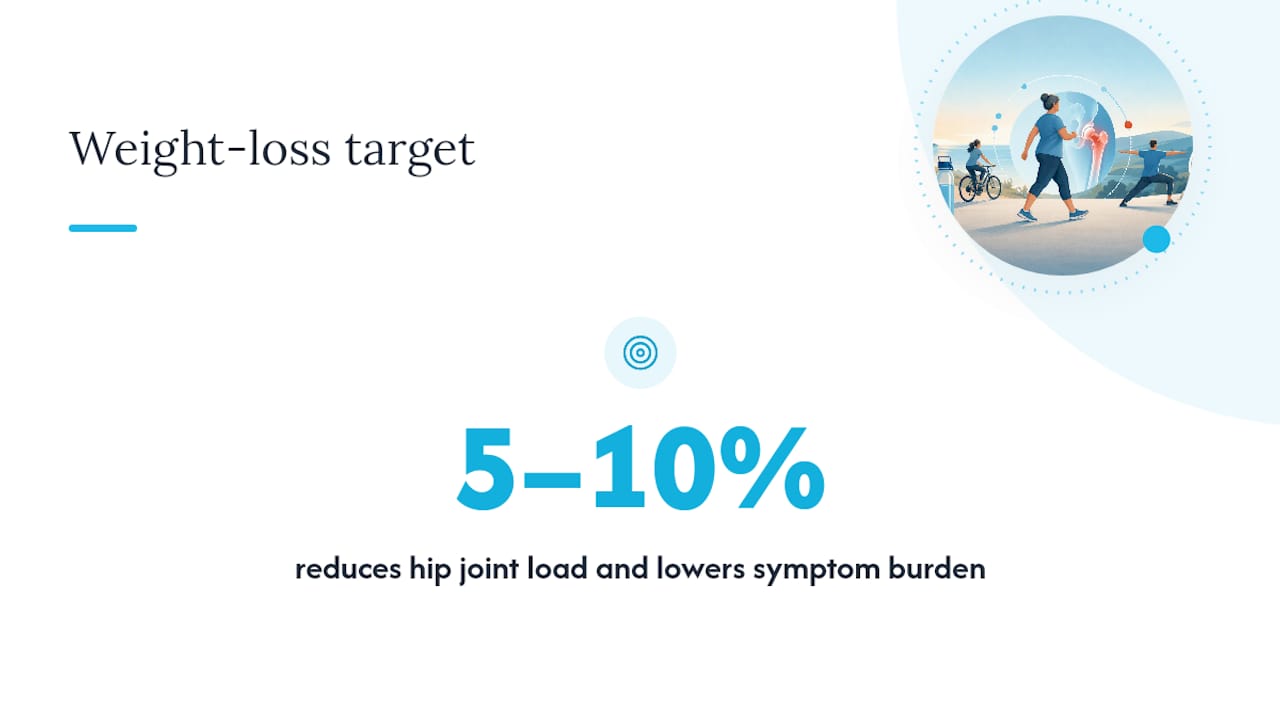
Every pound of body weight translates into several pounds of force across the hip during walking, so even modest weight loss reduces the mechanical load on the joint with every step. Guideline authors don’t promise weight loss will reverse joint damage, and it won’t. What it reliably does is lower symptom burden and slow the pace at which pain limits your activity. Set a realistic target, five to ten percent of body weight is a common clinical benchmark, rather than chasing a number that sets you up to quit in month two.
What Medications and Injections Help With Hip Arthritis Pain?
Oral NSAIDs remain the most strongly recommended medication for hip OA, and the evidence behind intra-articular corticosteroid injections is the next most solid, according to a comprehensive review of non-operative hip OA treatments. Everything else, acetaminophen, hyaluronic acid, PRP, sits on considerably shakier ground for the hip specifically.
NSAIDs like ibuprofen, naproxen, or prescription-strength options reduce inflammation and pain effectively for many patients. They’re not risk-free. Common contraindications include:
- A history of stomach ulcers or gastrointestinal bleeding
- Chronic kidney disease or reduced kidney function
- Uncontrolled high blood pressure or certain heart conditions
- Concurrent use of blood thinners, without medical supervision
Topical NSAIDs and capsaicin cream offer a lower-risk alternative, particularly for people who can’t tolerate oral anti-inflammatories. They work at the skin and superficial tissue level, so expect a milder effect than a pill, but also fewer systemic side effects. Capsaicin needs consistent daily application for one to two weeks before you’ll notice much, and it causes a temporary burning sensation that fades with repeated use.
Acetaminophen is often reached for first because it’s familiar and available without a prescription, but the evidence supporting it for hip OA specifically is weaker than for NSAIDs. It may still help as a lower-risk option for people who can’t take anti-inflammatories, just don’t expect it to match NSAID-level relief.
Corticosteroid injections: what to actually expect
Intra-articular corticosteroid injections carry a moderate-strength recommendation from the AAOS guideline for short-term improvement in pain and function. “Short-term” here typically means relief that lasts up to around four months, not a permanent fix.
Because the hip joint sits deep beneath muscle and fat, unlike the knee, providers need imaging guidance, usually ultrasound or fluoroscopy, to place the injection accurately. A hip injection given without image guidance carries a real risk of missing the joint space entirely.
Risks are uncommon but worth knowing:
- Joint infection, which is rare but serious and requires prompt medical attention
- A small subset of patients experience rapidly progressive OA following repeated injections
- Temporary increase in blood sugar for people with diabetes
Where hyaluronic acid and PRP stand
Hyaluronic acid injections, sometimes marketed as “gel shots,” are not recommended by the AAOS guideline for hip OA. The evidence simply doesn’t hold up the way it might for some knee OA cases. Platelet-rich plasma (PRP) and other biologic injections remain investigational for the hip. High-quality, hip-specific data is limited, and the non-operative treatment review notes that much of the injectable research base skews toward the knee, so don’t assume knee results transfer directly to your hip.
What Exercises Help Hip Osteoarthritis and How Do You Progress Them?
Movement is not the enemy here, inactivity is. Cleveland Clinic’s exercise guidance lists walking, swimming, cycling, and targeted strength work as the go-to low-impact options for maintaining hip function and keeping stiffness at bay. The instruction that matters most: work through mild discomfort, but stop if you feel sharp pain.
Exercise options worth building your routine around
- Sit-to-stand from a chair. Builds hip and thigh strength using a movement pattern you already perform dozens of times a day.
- Bridging. Lying on your back with knees bent, lifting the hips slightly off the floor, strengthens the glutes without loading the joint in a weight-bearing position.
- Sideways hip lift (clamshell or standing abduction). Targets the muscles that stabilize the hip during walking.
- Hip rotation while lying down. A gentle mobility drill that keeps the joint moving through its available range.
- Step-ups on a low step. Builds functional strength for stairs and uneven ground, started small and progressed gradually.
- Stationary cycling. Low-impact aerobic work that keeps the joint moving without pounding it.
- Aquatic exercise. Water’s buoyancy reduces joint load significantly, making it a strong option on higher-pain days.
How to dose exercise without overdoing it
- Start below your perceived limit. If you think you can do fifteen repetitions comfortably, start with ten.
- Use the 24-hour rule. Some soreness during or right after exercise is normal. Pain that’s noticeably worse the next day means you pushed too far.
- Progress one variable at a time. Add reps, then sets, then resistance or duration, but not all three in the same week.
- Reassess every two to three weeks. If pain and function are holding steady or improving, add a small increment. If not, hold at your current level.
The clinical line between a helpful program and a harmful one usually comes down to dose management: increasing load incrementally while watching closely for a persistent rise in pain or a loss of function, rather than a one-time sore muscle.
Handling a flare without losing your progress
Flares happen, even with a well-built program. When one hits, don’t stop moving entirely, but do scale back. Reduce your range of motion and resistance for a few days, swap standing exercises for aquatic or seated versions, and keep a short daily mobility routine going even if it’s only five minutes. Watch for these recovery markers before ramping back up: pain returning to your baseline level, and the ability to complete your usual daily activities without a noticeable limp or compensation pattern.
When to bring in supervised physical therapy
If you’ve been consistent with a home program for four to six weeks and you’re not seeing any change, or if you’re unsure whether you’re doing an exercise correctly, that’s the signal to get supervised physical therapy involved. A therapist can check your form, adjust load more precisely than you can on your own, and set measurable goals, like walking a specific distance without increased pain, or climbing a flight of stairs one step at a time instead of leading with the same leg every time. For readers dealing with hip tightness that limits how deep they can move, a few targeted movements to unlock the hips can be a useful starting point before committing to a full program.
What Home Remedies and Devices Reduce Hip Pain Day to Day?
Heat relaxes tight muscles around a stiff joint and works best before activity or in the morning when stiffness peaks. Cold reduces inflammation and works best after activity or during a flare, applied in 15 to 20 minute sessions.
- Topical NSAIDs and capsaicin cream offer localized relief with fewer systemic risks than oral medication, though capsaicin needs one to two weeks of consistent use before benefits show up clearly.
- A cane, held in the hand opposite the painful hip, shifts weight away from the joint and reduces load with every step. Measure it so your elbow bends about 15 to 20 degrees when your arm hangs at your side holding the handle.
- Supportive, cushioned footwear absorbs shock better than worn-out or flat, unsupportive shoes, and can noticeably reduce impact through the hip during walking.
- Raising chair and bed height reduces how far the hip has to flex to stand up or lie down, cutting strain on a stiff joint dozens of times a day.
- Adding a stair rail or using a step-together pattern on stairs reduces the demand on a single hip during a movement that’s otherwise hard to avoid.
When Should You Consider Hip Replacement Surgery?
Conservative care deserves a real trial before surgery enters the conversation, but it isn’t meant to be attempted forever if it clearly isn’t working. Clinicians generally expect several months of consistent, well-documented non-surgical treatment, exercise, weight management, medications, and possibly injections, before considering a referral reasonable.
Signs it’s time to talk to an orthopedic surgeon about a consult:
- Persistent, significant pain that continues despite a genuinely optimized non-surgical plan
- Loss of independence in daily activities: difficulty putting on shoes, getting in and out of a car, or walking a short distance without severe discomfort
- Night pain that consistently disrupts sleep despite medication and activity modification
- X-ray evidence of advanced joint space narrowing paired with symptoms that match the imaging
Total hip arthroplasty tends to produce the best outcomes in patients who’ve exhausted appropriate conservative measures and have clear functional limitation, rather than those who move to surgery early without giving non-surgical care a genuine chance to work.
How Hands-On Clinical Care Fits Into a Hip OA Plan
Exercise and medication address the joint and the inflammation. They don’t always address the soft tissue restrictions, the tight fascia, guarded muscles, and compensatory movement patterns, that build up around a painful hip over months or years and make home exercise harder than it should be.
That’s where a hands-on approach, like the Fascial Distortion Model used at The Tx Room, fits into the picture. FDM treats specific patterns of soft tissue distortion directly with manual technique, aiming to restore normal movement so the exercise and mobility work you’re already doing actually holds.
A stiff, guarded hip often resists home exercise not because the exercise is wrong, but because the surrounding soft tissue hasn’t been addressed. Hands-on release work can make the difference between an exercise program that stalls and one that progresses.
A typical visit follows a straightforward arc:
- An initial exam to assess joint mobility, muscle guarding, and movement compensation patterns
- Targeted manual therapy to address restrictions identified during that exam
- A home exercise progression built around what the exam actually found, not a generic handout
This isn’t a replacement for the exercise, weight management, and medication decisions covered above. It’s a complement, particularly for patients whose home program has plateaued or who’ve had trouble tolerating standard exercise because of underlying tightness.
Can Cognitive Behavioral Therapy Help With Hip Arthritis Pain?
Chronic joint pain isn’t purely mechanical. The nervous system’s relationship to pain shifts over months of dealing with a condition like hip OA, and fear of movement, frustration, and low mood all measurably amplify how pain gets experienced day to day.
Cognitive behavioral therapy (CBT) targets that piece directly. Rather than treating the joint, it works on the thought patterns and behaviors that make pain worse, catastrophizing a flare, avoiding all activity out of fear of triggering pain, or getting caught in a cycle of overdoing it on good days and crashing on bad ones. A CBT-based approach typically teaches pacing strategies, reframes unhelpful thoughts about pain and disability, and builds coping skills for flare days specifically.
You don’t need a formal diagnosis of anxiety or depression to benefit. Many hip OA patients carry low-grade anticipatory anxiety about movement, a hesitation that quietly limits activity more than the joint itself does. CBT interrupts that pattern by rebuilding confidence in movement through structured, graded exposure rather than avoidance.
It works best paired with, not instead of, the exercise and medical management already outlined. A psychologist or counselor trained in pain management can deliver this in a handful of sessions, and some physical therapy practices now integrate pain-focused CBT elements directly into rehab visits. If chronic pain has started shrinking your world, fewer outings, more time sitting, worsening mood, that’s worth raising with your primary care provider alongside your physical treatment plan.
Do Acupuncture and TENS Actually Ease Hip Osteoarthritis Pain?
Acupuncture and transcutaneous electrical nerve stimulation (TENS) sit in the complementary therapy category: neither replaces exercise or medication, but both can serve as reasonable add-ons for pain modulation.
Acupuncture involves inserting thin needles at specific points to influence pain signaling. Evidence for hip OA specifically is mixed and generally weaker than for knee OA, where more research exists. Some patients report meaningful short-term relief; others notice little difference. It’s low-risk when performed by a licensed practitioner, which makes it a reasonable trial for patients looking for an additional tool, as long as expectations stay realistic.
TENS units deliver a mild electrical current through electrode pads placed near the painful area, aiming to interrupt pain signals traveling to the brain. They’re inexpensive, available over the counter, and carry minimal risk. The relief tends to be temporary, lasting through and shortly after use, which makes TENS better suited as a situational tool, before a walk, during a flare, than a standalone treatment.
Neither therapy appears in the AAOS or AAFP guidelines as a primary recommendation, and that’s an honest gap in the evidence, not a dismissal. If you’re curious, try one for a defined trial period, four to six sessions, for example, and track your pain scores. If you’re not noticing a difference by then, it’s reasonable to redirect that time and money toward the exercise and strength work carrying stronger evidence.
Do Glucosamine and Chondroitin Actually Work for Hip OA?
Glucosamine and chondroitin remain two of the most widely purchased joint supplements, and the honest answer on hip OA is that the evidence doesn’t strongly support them. Trials have produced inconsistent results, and neither the AAOS nor AAFP guidance treats them as a recommended core treatment.
That doesn’t mean they’re dangerous. Both are generally well tolerated, with mild gastrointestinal upset as the most common side effect. If you’re already taking blood thinners, check with your physician first, since some formulations may interact.
Other supplements circulating in hip OA discussions, turmeric or curcumin extracts, fish oil, and collagen peptides, have smaller and less consistent evidence bases than glucosamine and chondroitin. Some patients report subjective improvement; the research doesn’t reliably back that up across the board.
If you choose to try a supplement, treat it as a low-priority addition rather than a core strategy. Give it a defined trial window, three months is common, and evaluate honestly whether your pain or function has actually changed. Money and effort spent here should never come at the expense of the exercise, weight management, and medication strategies with real guideline backing behind them. And always mention any supplement to your physician, particularly if you’re on other medications, since “natural” doesn’t mean risk-free.
How Do You Recognize and Manage a Hip OA Flare?
Hip OA pain isn’t constant. It flares in response to identifiable triggers, and learning yours is one of the more underrated skills in managing this condition long-term.

Common triggers include a sudden jump in activity (a long hike after weeks of inactivity), prolonged sitting followed by standing up too fast, cold or damp weather, poor sleep, and emotional stress, which measurably lowers pain tolerance even without any change in the joint itself.
Start a simple log for two to three weeks: activity level, weather, sleep quality, and pain score each evening. Patterns usually surface faster than people expect, and once you know your specific triggers, you can plan around them rather than getting blindsided.
When a flare hits, the goal is calming things down without stopping movement altogether. Reduce your exercise load temporarily rather than eliminating it, apply cold to calm acute inflammation, and lean on your cane or supportive footwear more heavily for a few days. Most flares settle within a week to ten days with this kind of measured response. If a flare lasts substantially longer than that or arrives with new symptoms, like fever, significant swelling, or redness, that warrants a call to your provider rather than waiting it out.
What Daily Habits Help Prevent Hip Pain Flare-Ups?
Beyond structured exercise, the small choices that fill the rest of your day add up. Prolonged static positions, sitting at a desk for hours, standing in one spot at a counter, stiffen the hip more than most people realize. Building in a position change every 30 to 45 minutes keeps the joint from locking up.
Alternating higher-demand days with lighter ones prevents the boom-and-bust cycle that triggers flares: a big yard work day followed by three days of being unable to walk comfortably. Spreading physical demands more evenly across the week, even if it means breaking one big task into three smaller sessions, tends to produce steadier symptom control.
Sleep position matters more than people expect. Side sleeping with a pillow between the knees keeps the hip in a neutral position and reduces overnight stiffness for many patients. Back sleeping with a pillow under the knees works as an alternative if side sleeping isn’t comfortable.
Carrying loads asymmetrically, a heavy bag on one shoulder, a child on one hip, adds uneven stress to the joint over time. Splitting loads or using a backpack instead distributes that stress more evenly. None of these changes will eliminate hip OA pain on their own, but stacked together with exercise, weight management, and appropriate medication use, they reduce how often you’re caught off guard by a flare you didn’t see coming.
An Honest Take on What Actually Moves the Needle
The guidelines are right about the fundamentals, exercise, weight management, and education really are first-line care, not a stalling tactic before “real” treatment. Where conventional advice falls short is in how it’s delivered: a printed handout with five stick-figure exercises isn’t an individualized plan, and it’s a big reason so many patients never receive the full spectrum of recommended conservative care that guidelines actually call for.
What’s overrated, in my view, is the injectable arms race, chasing hyaluronic acid or PRP based on marketing rather than evidence. What’s underrated is dose management. Most people either do too little out of fear or too much out of frustration, and both paths stall progress. The reader’s real first move isn’t a new supplement or a stronger prescription. It’s building a small, consistent exercise routine, tracked honestly for a few weeks, and pairing it with hands-on care when tightness or guarding is clearly limiting what the exercises alone can fix.
— Chris
Where The Tx Room Fits Into Your Hip OA Recovery
If you’ve been doing the exercises, watching your weight, and still feel like your hip is fighting you every morning, Thetxroom offers something the guidelines recommend but rarely explain how to access: hands-on treatment that targets the soft tissue restrictions actually limiting your progress. Using the Fascial Distortion Model, Thetxroom identifies and treats the specific tissue patterns behind stiffness and guarding, then builds a home exercise progression around what that exam finds, rather than a generic printout.

This approach fits naturally alongside everything covered above: it doesn’t replace your exercise plan, your physician’s medication guidance, or a future surgical conversation if you get there. It fills the gap between them, addressing why a home program sometimes stalls even when you’re doing everything right. Patients dealing with related soft tissue and joint issues have found similar relief through Thetxroom’s work on joint inflammation and tendinitis care in Plano.
If your hip pain has plateaued despite consistent effort, book an evaluation with Thetxroom and get a tailored assessment of what’s actually holding your recovery back.
Sources
- Hip Osteoarthritis: Guidelines From the American Academy of Orthopaedic Surgeons | AFP
- Non-operative Treatment Options for Osteoarthritis in the Hip
- Management of Osteoarthritis of the Hip (AAOS clinical practice guideline)
- 5 Best Exercise Types for Hip Arthritis (Cleveland Clinic)