
Chronic Ankle Instability: Causes, Tests and Treatment
Chronic ankle instability (CAI) is what happens when an ankle that was sprained once keeps rolling or “giving way” afterward, often on ordinary ground and with little warning. It is not a personality flaw of your ankle, and it is rarely fixed by waiting. Most people improve with a structured, progressive rehab program, and a smaller group needs surgery. Below we explain what is going on inside the joint, how clinicians confirm it, what a realistic nonsurgical plan looks like, and when it is time to get hands-on help.
TL;DR
- CAI is repeated giving way, a wobbly or unreliable ankle, and lingering pain or swelling after one or more sprains. Roughly 10% to 30% of people with an acute lateral ankle sprain go on to develop it.
- Two things drive it: loose ligaments (mechanical instability) and a nervous system that no longer controls the joint well (functional instability). Most people have some of both.
- First-line care is an individualized rehab program of at least three months, plus bracing or taping. Pain pills do not fix the instability.
- Surgery is usually considered only after 3 to 6 months of good nonoperative care has failed.
- If your ankle gives way more than once, get it examined rather than trusting a brace and hoping.
Table of Contents
- What chronic ankle instability feels like
- Why one sprain turns into repeated giving way
- How chronic ankle instability is diagnosed
- Nonsurgical treatment: what the evidence supports
- Our perspective: treat the whole pattern, not just the ankle
- Getting back to sport without getting stuck again
- When surgery is considered
- How to reduce the risk of another episode
- Who we help and how to start in Plano
- FAQ
- Sources
What chronic ankle instability feels like
People describe it in a few consistent ways:
- The ankle gives way when you step off a curb, walk on grass or gravel, or cut during a game.
- The ankle feels loose, wobbly or “not trustworthy,” even when nothing dramatic happens.
- Pain and swelling on the outer side of the ankle that flare after activity.
- Repeated “minor” sprains that you stop bothering to ice or mention to anyone.
- Hesitation: you shorten your stride, avoid uneven surfaces or skip the sport you used to love.
The research literature defines CAI as recurring instances of the ankle giving way with persistent symptoms such as pain and diminished function. Notice that definition is about what you experience, not just what an MRI shows. Some people with very loose ligaments on exam feel fine, and some with a normal-looking scan feel the ankle bail on them every week. That is why a good evaluation looks at the whole person and not just a picture.
The American Academy of Orthopaedic Surgeons notes that repeated ankle sprains can lead to long-term problems, including chronic ankle pain, arthritis, and instability. That is the main reason not to shrug off a “funny ankle.”
Why one sprain turns into repeated giving way
Most lateral ankle sprains (the foot rolls inward and the outer ligaments stretch or tear) heal well. In a meaningful minority, they do not. A review of lateral sprain and CAI puts the figure at about 10% to 30% of acute lateral sprains developing into chronic instability.
There are two broad ways it happens, and the same review describes them as mechanical instability from ligament laxity or functional instability from impaired proprioception and neuromuscular control.
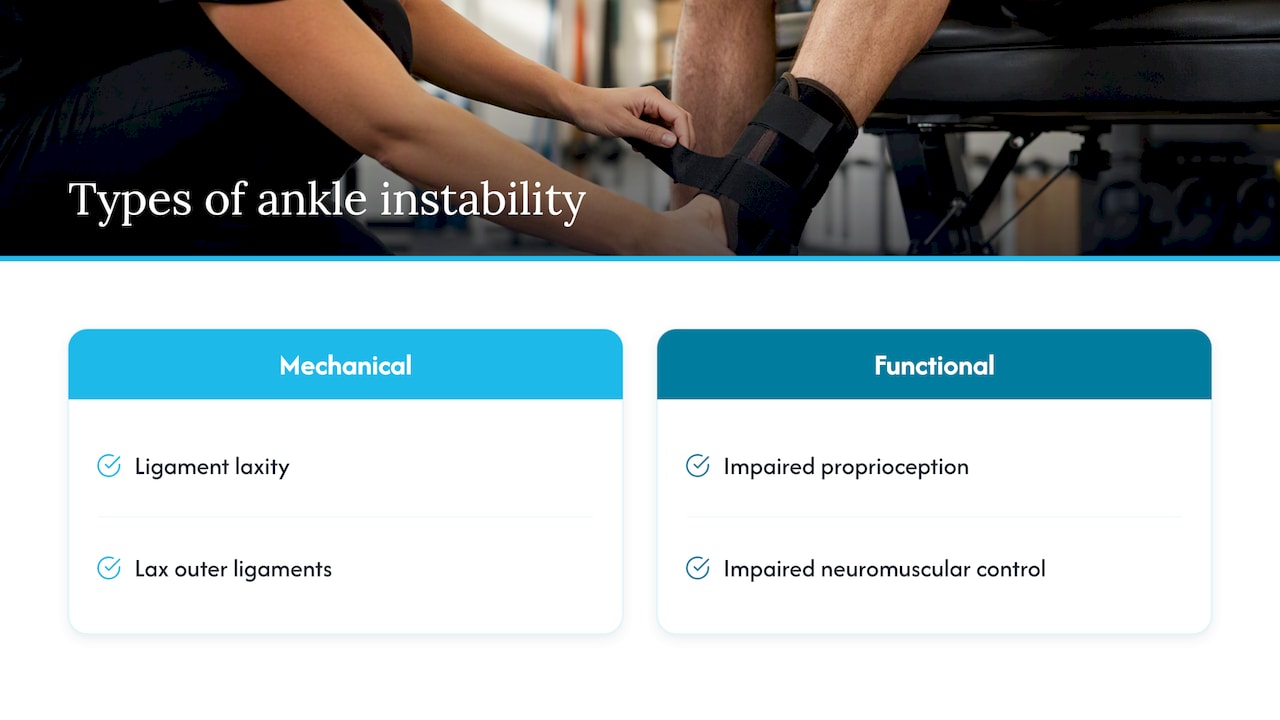
Mechanical: the ligaments healed long or loose
The ligaments on the outside of the ankle can heal in a lengthened state, or scar in a way that never restores their original tension. The joint then allows more movement than it should, and a small twist that your ankle used to absorb now becomes a full roll.
Functional: the ankle’s “software” is off
Proprioception is your sense of where the joint is in space. After a sprain, the sensors in the ligaments and capsule are damaged and the muscles that react to a sudden tilt, especially the peroneals on the outside of the lower leg, can fire late or weakly. You do not feel “loose” so much as caught off guard.
Why it is bigger than one ligament
Researchers now describe CAI as interrelated pathomechanical, sensory-perceptual and motor-behavioral impairments within a biopsychosocial model. In plain words: structure, sensation, movement habits and confidence all feed one another. If you stop trusting the ankle, you move differently, you load it less, it gets weaker, and it gives way again. Good treatment has to break that loop at more than one point.
Other things that commonly contribute, based on what we see clinically:
- A first sprain that was never rehabbed, just “walked off.”
- Returning to sport on the strength of pain relief alone.
- Stiff calf or ankle joint mobility, which pushes forces onto the ligaments.
- Weak hips and a poor landing pattern further up the chain.
- Foot posture, such as a high-arched, supinated foot that rolls outward easily.
How chronic ankle instability is diagnosed
There is no single test. A thorough evaluation combines three things, according to the same lateral ankle sprain and CAI review:
- A detailed history. How many sprains, when, how severe, what you did after, and what the ankle does now. How often it gives way matters more than how bad the first sprain was.
- A hands-on exam. Manual stress tests such as the anterior drawer and talar tilt check how much the joint glides or tips compared with the other side. Your clinician also checks balance, strength, range of motion and how you walk, hop and land.
- Imaging when it is warranted. X-rays or MRI help find associated damage such as cartilage injury, bone problems or tendon tears. Stress radiographs can show laxity visually, though the cutoff values for diagnosis vary.
To give you a sense of the numbers surgeons look at, one study of stress radiography listed a tibiotalar tilt over 15° or a side-to-side difference over 10°, and anterior talar translation over 10 mm or a side-to-side difference over 3 mm as radiographic criteria for surgery. Those figures are used to plan surgery, not to tell you whether you personally need it. Plenty of people with some laxity do well with rehab.
See a clinician promptly, and ideally before more rolling, if you have any of these: significant swelling that lingers for weeks, pain directly on the bone, trouble putting weight on the foot, numbness or tingling, or a sense of locking or catching. The AAOS lists lasting swelling and pain after several weeks of conservative care and difficulty bearing weight as reasons to be seen by a medical professional to rule out a severe sprain or fracture.
Nonsurgical treatment: what the evidence supports
For most people, the first answer is not an operation. The review describes nonsurgical treatment as an individualized rehabilitation program for at least three months, plus bracing or taping to help prevent future sprains. Three months is a floor, not a promise of a quick fix, and it is the point many people miss: a week of calf raises is not a program.
What a good rehab program contains
The same source lists multidirectional strengthening, proprioceptive training, peroneal strengthening, and sport-specific training for athletes. In practice, a progression usually looks like this:
| Phase | Focus | Examples |
|---|---|---|
| 1. Calm and restore motion | Reduce irritation, regain ankle and calf mobility, begin gentle loading | Ankle pumps, calf and joint mobility work, double-leg balance |
| 2. Strength | Build the peroneals, calf, foot and hip in several directions | Banded eversion, heel raises, single-leg bridges, step-downs |
| 3. Balance and proprioception | Retrain reaction to being off balance | Single-leg stance on firm then soft surfaces, eyes-closed holds, reaching drills |
| 4. Power and landing | Teach the ankle to absorb force | Hops, lateral bounds, controlled landings |
| 5. Sport or job specific | Rehearse the exact demand that makes it give way | Cutting, change of direction, uneven terrain, ladder or long-shift standing |
The timing varies by person, and you should move forward on criteria (control, no swelling afterward, symmetry) rather than on the calendar. For general milestones of ligament healing, our guides on ligament sprain recovery milestones and starting rehab in the first 48 to 72 hours show what the early weeks should look like.
Braces and tape
Bracing and taping are support, not treatment. They can lower the odds of another roll while you rebuild strength and control. A systematic review of orthoses, taping and insoles in people with CAI examined their effect on postural stability, which is the reason clinicians use them during higher-risk activity. Think of a brace as a seatbelt: wear it when the risk is high, and keep building the strength that makes you need it less.

Pain medicine
NSAIDs such as ibuprofen may provide short-term pain relief and reduce swelling, but have no long-term effect on chronic ankle instability symptoms. They can make a flare-up more comfortable. They will not tighten a ligament or retrain a reflex. Check with your physician or pharmacist about what is safe for you.
Where manual therapy fits
Stiff, guarded tissue around an unstable ankle is common. The calf, the peroneal muscles and the fascia on the outer lower leg often tighten to protect the joint, and that tightness can limit the motion you need to do rehab well. Hands-on work does not replace strengthening and balance training, but it can make the exercises easier to perform properly. We cover this approach in more detail on our pages about fascia work paired with rehab and myofascial release.
Our perspective: treat the whole pattern, not just the ankle
We see many people who have been told some version of “wear a brace and strengthen it” and who are still rolling the ankle months later. When that happens, the missing piece is usually not effort. It is the specific restriction or weakness that keeps the ankle from doing its job.
Our approach at The Tx Room is hands-on and built around the Fascial Distortion Model, along with myotherapy and individualized rehab plans. We look for what is limiting the foot, ankle, calf and hip, and we treat that so the loading work you do afterward can actually take. We pay particular attention to cases that have not improved with standard medical or physical therapy, because those patients often have a stuck tissue or movement pattern nobody has addressed directly.
Two honest points. First, no manual technique replaces progressive strengthening and balance work for CAI; the evidence points to rehab as the backbone. Second, if your ankle has a structural problem that needs a surgeon, we will tell you rather than keep you in treatment you do not need. Our job is to get you functional and confident, and to refer when the situation calls for it.
— Chris
Getting back to sport without getting stuck again
The moment people re-injure is usually the moment they return too early: the pain is gone, so the ankle must be ready. Pain is a poor guide. A better set of checks before you go back to full play:
- You can stand on the injured leg with eyes closed for 30 seconds without wobbling much.
- Single-leg heel raises and hops are close to the other side in height and control.
- You can cut, pivot and land without the ankle “catching.”
- There is no swelling or ache the next morning after a hard session.
- You feel confident, because fear changes how you move.
If you play field sports, a staged plan for getting back to football after an injury shows how milestones and match readiness fit together. For ligament injuries more broadly, our return-to-sport timeline explains why tissue needs far longer than symptoms do.
Related problems can mimic or accompany CAI. Outer-ankle pain may actually come from the tendons that run behind the fibula, so see our guide to peroneal tendonitis treatment. A foot that rolls outward can be part of the story too, which we discuss in supination treatment. If the sprain was higher up and involved the ligaments between the shin bones, the rehab differs, and high ankle sprain rehab covers it.
When surgery is considered
Surgery is not the starting point. A review of surgical management says it may be considered after patients fail to improve following 3 to 6 months of nonoperative management. Reasons to talk to a foot and ankle surgeon sooner include a clearly torn ligament with a high-level athletic demand, other damage found on imaging, or repeated giving way despite honest rehab.
What the evidence says about common procedures:
- Anatomic repair. The same review reports that anatomic repair using a modification of the Broström procedure is the preferred technique for initial surgery. The surgeon tightens and reattaches the native ligaments.
- Arthroscopic versus open. A comparison of the two found that arthroscopic Broström surgery showed better postoperative AOFAS scores, pain scores, and time to return to weightbearing than the open Broström-Gould operation.
- Early weightbearing. In a study of suture tape–augmented repair, patients were allowed immediate weightbearing as tolerated, and 95% had returned to sport at one-year follow-up. That is one study of one technique, not a guarantee for every patient or surgeon.
Surgery does not end the work. Postoperative protocols and return to activity vary with the procedure and the rehab that follows, so you still need a strength, balance and landing program afterward.
How to reduce the risk of another episode
The same review ties risk reduction to rehabilitation that addresses proprioception and other individual needs, along with bracing or taping. Practical habits that fit that advice:
- Keep a short balance routine. Five minutes of single-leg stance, a few times a week, is worth more than an occasional long session.
- Keep strengthening. Peroneals, calves and hips do not stay strong on their own.
- Support high-risk activity. Use a brace or tape for sports and for rough terrain while the ankle is still earning back trust.
- Choose sensible footwear. Worn-out or unstable shoes make uneven ground riskier.
- Treat each new roll seriously. Early rehab after any new sprain is much cheaper than another round of chronic instability.
- Address the neighbors. A tight calf, weak hip or a foot that tips outward may be loading the ankle on every step.
Who we help and how to start in Plano
We work with athletes, parents who cannot afford weeks of downtime, workers on their feet all day, and students and desk workers whose posture and gait have shifted since an old injury. If your ankle has been giving way and you want a clear, hands-on evaluation in Plano, Texas, our chiropractic and soft tissue care is the place to begin. Depending on what the exam shows, your plan may include the Fascial Distortion Model, dry needling for stubborn muscle tension, or focused shockwave (MyACT), always paired with a rehab plan built around how your ankle actually behaves. We accept both self-pay and insurance; call the clinic to confirm your coverage and the cost of your first visit.
FAQ
Can chronic ankle instability heal on its own?
Usually not completely. Lax ligaments and a weakened sense of joint position do not reliably recover without targeted training. Most people improve with an individualized rehab program that lasts at least three months, along with bracing or taping when the risk is high.
Why does my ankle keep giving way even though the sprain was years ago?
The original injury can leave behind two problems: ligaments that healed loose, and muscles and nerves that react too slowly to a sudden tilt. Over time, protective habits and weakness can add to it. The good news is that proprioception and strength are trainable, even years later.
Do I need an MRI or X-ray?
Not always. Diagnosis rests on your history and a hands-on exam, and imaging is added when a clinician suspects other damage, such as cartilage, bone or tendon problems, or when surgery is being considered. Ask for imaging if pain, swelling or locking persists.
When should I consider surgery?
Surgery is generally considered after 3 to 6 months of well-run nonoperative care has not worked, or earlier if imaging shows additional structural injury. A foot and ankle surgeon can tell you whether you are a candidate and which technique fits your ankle.
Is a brace enough?
A brace helps protect the ankle during risky activity, but it does not restore strength, balance or reaction time. Use it as support alongside a structured rehab program, not as a replacement for one.
Sources
- Lateral Ankle Sprain and Chronic Ankle Instability (PMC)
- An Updated Model of Chronic Ankle Instability (PMC)
- Surgical Management of Lateral Ankle Instability (PMC)
- Consistency and Reliability of Ankle Stress Radiography (PMC)
- Outcomes of Open Versus Arthroscopic Broström Surgery (PMC)
- Immediate Weightbearing After Augmented Modified Broström (PubMed)
- Effects of Ankle Orthoses, Taping, and Insoles in Chronic Ankle Instability (PMC)
- Sprained Ankle (OrthoInfo, AAOS)