
Ankle Sprain Rehab: Phases, Exercises and Timeline
Good ankle sprain rehab starts early and moves in stages: protect the joint for a few days, regain motion, rebuild strength, then retrain balance and sport movements. Most sprains heal well, but the ankles that get stuck are usually the ones that skipped a stage. If yours is not improving, hands-on care in Plano with The Tx Room can help get rehab moving again.
TL;DR
- Rest, elevate and ice for the first 24 to 48 hours, then start moving as pain allows.
- Rehab has overlapping phases: protected motion, strength, then balance and return to sport.
- Plan on 8 to 12 weeks of targeted rehab for a full return, even when walking feels normal sooner.
- Get checked for severe pain, an inability to bear weight, a deformed ankle or swelling that does not improve.
- Stalled recovery, repeat sprains or a stiff, swollen ankle at week 3 or 4 are reasons to get hands-on help.
Table of Contents
- What to do in the first days
- How bad is your sprain?
- The phases of ankle sprain rehab
- How long does ankle sprain rehab take?
- Where hands-on care fits
- Our perspective
- Treatment options at The Tx Room
- FAQ
- Sources
What to do in the first days
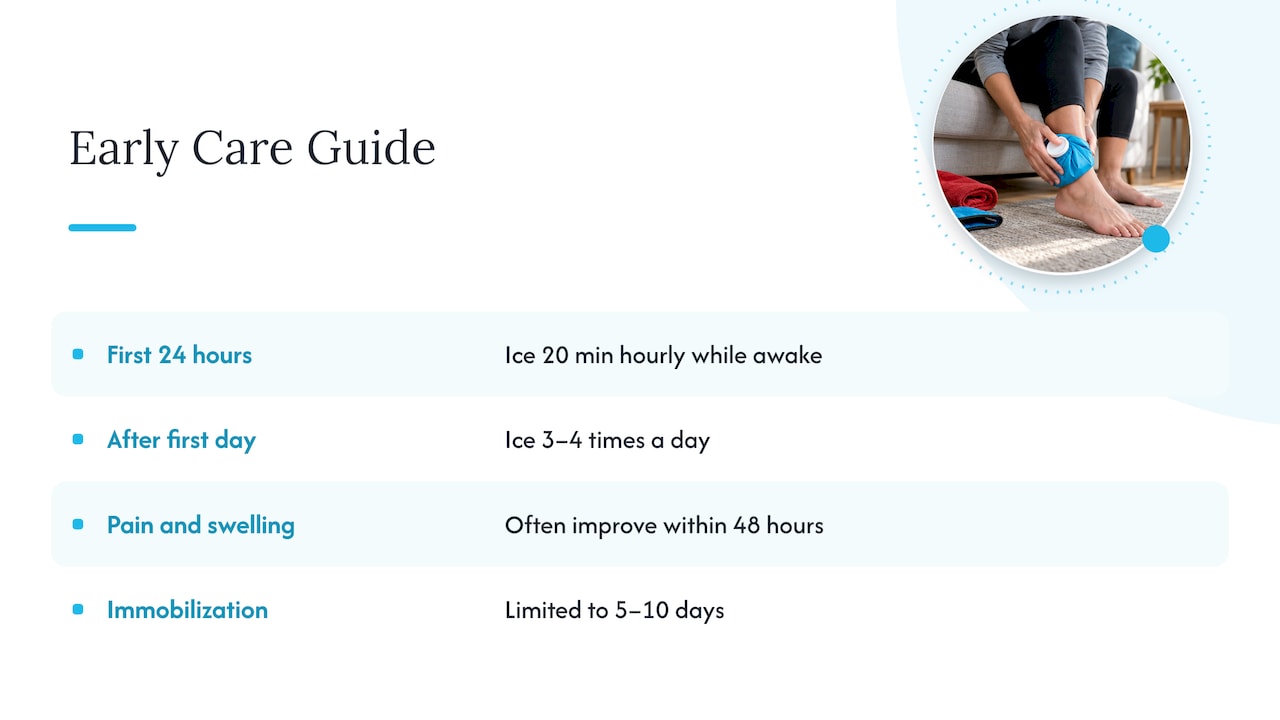
The first goal is to calm pain and swelling without keeping the ankle still for too long. MedlinePlus advises resting and staying off the foot, elevating it at or above heart level, and icing for 20 minutes at a time every hour while awake during the first 24 hours. After that, ice 3 to 4 times a day. Pain and swelling most often improve within 48 hours, and weight bearing can then resume gradually.
The American Family Physician review from December 2025 describes limited immobilization for 5 to 10 days, followed by early functional activity and targeted exercises, with an external ankle support during recovery. Early, gentle movement beats long rest.
When to get examined first
Mayo Clinic says to seek medical attention right away for severe pain or swelling, pain that keeps getting worse, an open wound, a deformed ankle, signs of infection, or if you cannot put weight on the foot. Book a visit if swelling has not improved after 2 to 5 days of home care. You may have a torn ligament or a broken bone, and exercises only help once that is ruled out. The AFP notes that an exam 4 to 7 days after injury gives a more accurate read on severity, and that the Ottawa Foot and Ankle rules help clinicians decide when an X-ray is not needed.
How bad is your sprain?
Severity sets the pace. The MSD Manual describes three grades:
| Grade | What happened | Typical care |
|---|---|---|
| 1 (mild) | Ligament stretched or with tiny tears | Rest, ice, compression, elevation, then weight bearing and movement as soon as tolerated, usually within a few days |
| 2 (moderate) | Partial ligament tear | The same, plus a splint or boot in a neutral position, then mobilization and physical therapy |
| 3 (severe) | Complete tear | Longer immobilization, sometimes a cast or surgical repair, then physical therapy |
The phases of ankle sprain rehab
Clinical guidelines describe a progression rather than a calendar. The JOSPT clinical practice guideline splits lateral ankle sprain rehab into two main phases, and the Vanderbilt Sports Medicine guidelines break them down further.
Phase 1: protected motion
The aims are less swelling, pain-free motion and a normal walking pattern. You use crutches or a brace if needed, wean off as pain allows, and become independent with a home exercise program. Typical work:
- Ankle pumps and ankle circles, or tracing the alphabet with your toes.
- Gentle calf stretching with a towel around the foot.
- Isometric holds, pushing the foot into a wall or your hand without moving the joint.
A 2020 review of acute ankle sprain in athletes says range-of-motion work can often start right away in grade I and II injuries, as soon as pain permits, but may need to wait in grade III.
Phase 2: strength
Strength work begins once motion is close to normal. The same review recommends starting with isometrics, then progressing to resistance with bands or weights, using light resistance and two to four sets of 10 repetitions. Prioritize the peroneal muscles on the outside of the lower leg: weaker eversion strength has been linked to repeat sprains and chronic instability. Bilateral standing toe raises through the full range also help.
A simple progression: band eversion and inversion, then heel raises on two feet, then one foot, then heel dips off a step. Move up only when the last step is pain-free the next morning.

Phase 3: balance and sport-specific work
The second JOSPT phase focuses on coordination and postural control: single-leg balance, then unstable surfaces, then hopping, cutting and sport drills. The guideline notes that balance and sport-related training can lower the risk of recurring sprains in athletes. This is the phase most people skip, because the ankle feels fine for walking. It is also the phase that protects you from the next sprain. If balance work interests you more broadly, safe balance training exercises show how progressive loading builds stability.
A quick self-check: stand on the injured leg with eyes open for 30 seconds, then try it with eyes closed. If it wobbles far more than the other side, the balance phase is not done.
How long does ankle sprain rehab take?
The AFP describes a targeted neuromuscular rehabilitation program of 8 to 12 weeks. Mild sprains often feel better in one to two weeks, while complete tears can take months, according to the same body of guidance. Severity, whether you needed immobilization or surgery, and how consistently you did the exercises all change the timeline. Feeling good at week 2 does not mean the ligament has finished remodeling. A 2025 systematic review describes return to sport as a continuous process shaped by injury extent, cause, treatment and recovery criteria, not a single date.
Signs you are ready to return to activity
- Full, pain-free motion compared with the other ankle.
- Strength you can see on single-leg heel raises and band work.
- Steady single-leg balance, eyes open and closed.
- Hopping and cutting without pain, swelling or giving way.
Where hands-on care fits
The JOSPT guideline recommends manual therapy, such as graded joint mobilization and mobilization with movement, to improve dorsiflexion, proprioception and weight-bearing tolerance during the loading phase. That is where many stubborn ankles are stuck: a stiff joint, tight fascia or scar tissue that exercises alone do not release.
If you are a runner, a parent who cannot afford a slow recovery or a worker on your feet all day, these pages go deeper:
- Starting rehab in the first 48 to 72 hours
- Ligament sprain recovery milestones
- High ankle sprain rehab
- Chronic ankle instability
- Peroneal tendonitis treatment
- What chiropractic can do for a sprain
Our perspective
Most people we would want to help with an ankle sprain are not stuck because they did not rest enough. They are stuck because the ankle never got its motion, tissue quality and strength back in the right order.
At The Tx Room we treat musculoskeletal injuries hands-on, using the Fascial Distortion Model, myotherapy and individualized rehabilitation plans. We focus on cases that have not improved with standard medical or physical therapy approaches. Fascial work restores motion so the exercises in this guide can actually do their job.
Rehab works best when treatment and exercise are matched to the phase you are in. That is why we build the plan around you, whether you are an athlete, a parent or someone on your feet all day.
Chris
Treatment options at The Tx Room
The Tx Room is a chiropractic center in Plano, Texas. For ankle sprains and the soft tissue problems that follow, we offer the Fascial Distortion Model, dry needling, MyACT focused shockwave, deep tissue laser therapy and chiropractic and soft tissue care, with self-pay and insurance accepted. Book a visit and we will build your rehab plan from your first exam.

FAQ
How long does it take to rehab a sprained ankle?
Mild sprains often improve within one to two weeks, while the AFP describes a targeted rehab program of 8 to 12 weeks. Severity and consistency with exercises set your timeline.
When can I start rehab for a sprained ankle?
Usually within days. Rest and ice for the first 24 to 48 hours, then begin gentle motion as pain allows, once a fracture has been ruled out when you have warning signs.
What are the stages of ankle sprain rehab?
Protected motion to settle swelling and restore pain-free movement, strengthening starting with isometrics, then balance and sport-specific training.
Should I keep walking on a sprained ankle?
For minor sprains, gradual weight bearing is part of recovery once pain and swelling ease, often after about 48 hours. If you cannot put weight on the foot, get it examined.
Sources
- MedlinePlus: Ankle sprain aftercare
- American Family Physician: Management of Acute Ankle Sprains (2025)
- MSD Manual: Ankle Sprains
- JOSPT Ankle Sprain Clinical Practice Guideline (2013)
- Vanderbilt Sports Medicine Ankle Sprain Guidelines
- Acute ankle sprain in athletes (PMC, 2020)
- Return to sport after lateral ankle sprain (PMC, 2025)