
Plantar Fasciitis Recovery Time: What to Expect Week by Week
Most people with plantar fasciitis get better within a few months, and Mayo Clinic notes that simple, non-surgical care is usually enough. The honest range is wide, though. Some people feel real relief in a few weeks, and stubborn cases take 6 to 12 months or longer. What decides where you land is how early you start, how consistently you treat the heel, and what is loading your foot every day. This guide lays out the timeline, the milestones to watch for, and the signs that it is time to get a hands-on evaluation.
TL;DR
- Plantar fasciitis typically resolves in about 3 to 6 months with conservative care, and a 2020 review reports that about 90% of patients reach resolution of pain with nonoperative treatment.
- Symptoms should start easing soon after treatment begins. If nothing has changed after two weeks, get the heel examined.
- Starting early, fixing the load on your foot (tight calves, footwear, activity) and staying consistent are what shorten recovery.
- Chronic cases, meaning heel pain that has gone on for months, usually need a more structured plan than rest and stretching alone.
- Hands-on soft tissue care can be part of that plan. We use it at The Tx Room in Plano, TX.
Table of Contents
- How Long Plantar Fasciitis Really Takes to Heal
- The Three Phases of Recovery
- What Makes Recovery Faster or Slower
- Ice, Heat and Home Care During Recovery
- Our Perspective on Getting Out of the Slow Lane
- Hands-On Options That Can Support Recovery
- When Heel Pain Needs a Closer Look
- Book a Heel Evaluation in Plano
- FAQ
- Sources
How Long Plantar Fasciitis Really Takes to Heal
The answer depends on which source you read, because they measure different things: first relief, being back to normal walking, or being back to full sport. Here is how the major sources line up.
| Source | What it says about timing |
|---|---|
| Mayo Clinic | Most people recover within a few months with simple, non-surgical treatment |
| Cleveland Clinic | Symptoms should begin improving as treatment starts; full healing can take a few weeks to a few months |
| 2020 peer-reviewed review (Latt et al.) | About 90% of patients achieve complete pain resolution with nonoperative care, which can take 3 to 6 months |
| MyHealth Alberta | Non-surgical treatments may take 6 to 12 months to relieve heel pain |
Put together, a realistic expectation looks like this:
- Mild, early cases: noticeable improvement in the first few weeks, with most daily symptoms settling over a couple of months.
- Typical cases: 3 to 6 months of consistent care before the heel feels reliably normal.
- Long-standing cases: 6 to 12 months, sometimes more, especially when the heel has hurt for a long time before any treatment started.
That last group matters. The APTA guidelines, as summarized in American Family Physician, note that the gradual pain at the heel often lasts more than a year before people seek treatment. The longer the tissue has been irritated, the more it behaves like a degenerative problem and the less it behaves like a simple flare-up. The same guidelines describe plantar fasciitis as having both inflammatory and degenerative characteristics.
The Three Phases of Recovery
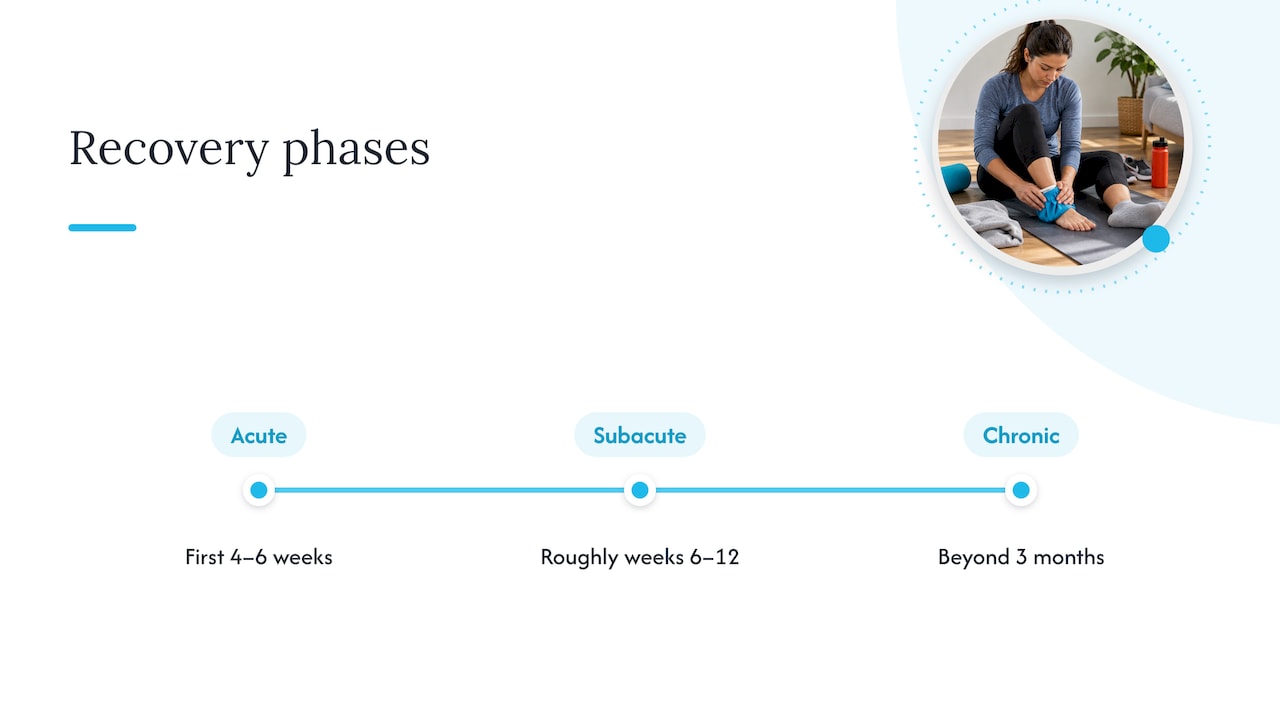
The American College of Foot and Ankle Surgeons describes three phases in its clinical consensus statement: acute (the first 4 to 6 weeks), subacute (roughly weeks 6 to 12) and chronic (beyond 3 months). Knowing which phase you are in helps you set the right goal.
Weeks 1 to 6: calming the heel
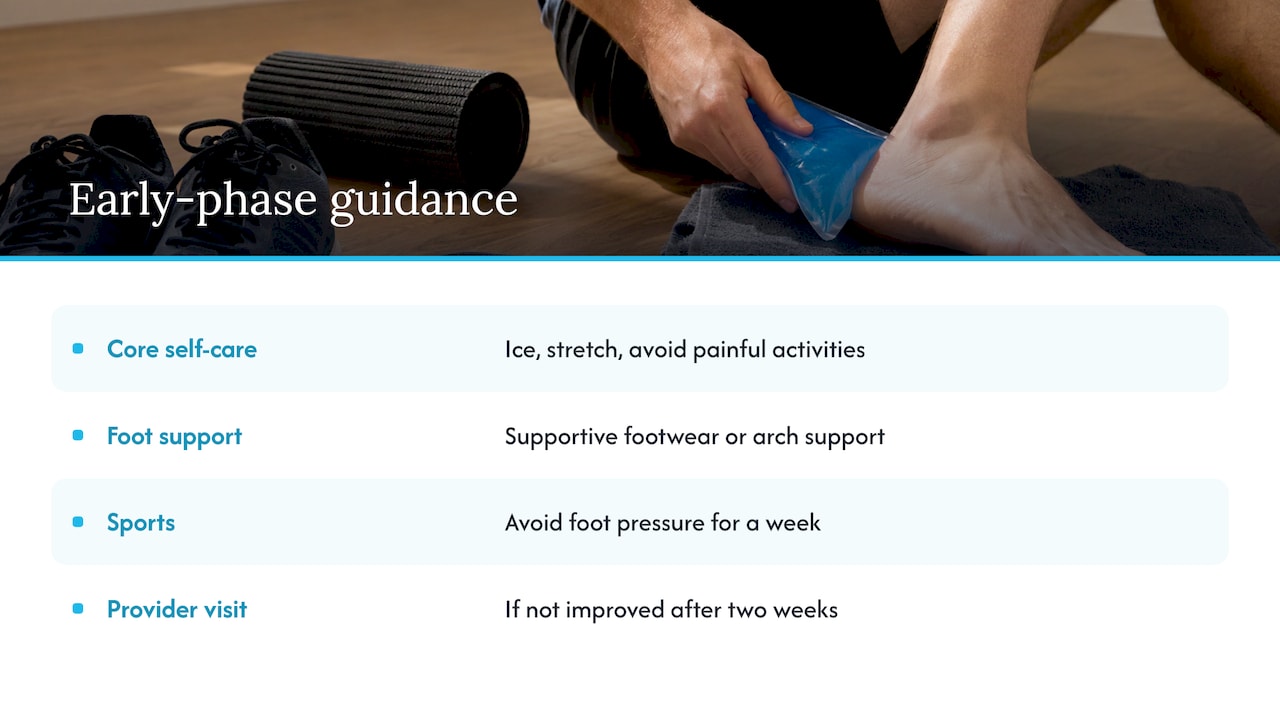
The aim here is to stop re-irritating the tissue. Typical steps include icing, relative rest from the activities that provoke pain, supportive footwear or an arch support, and daily calf and plantar fascia stretching. Mayo Clinic lists icing, stretching and avoiding painful activities as the core self-care.
The Cleveland Clinic says to expect improvement soon after treatment starts, and to see a healthcare provider if symptoms have not improved after two weeks. It also suggests avoiding sports and other activities that put pressure on your feet for at least a week.
What “better” looks like in this phase: your first steps out of bed hurt a little less, and ordinary walking is easier. The pain does not need to be gone.
Weeks 6 to 12: rebuilding capacity
Once the heel is calmer, the work shifts from protecting it to loading it again. That usually means progressive strengthening of the calf and the small muscles of the foot, along with continued stretching. This is where many people stall: the pain eases, they stop doing the exercises, and the heel flares up again with the first long walk or run.
What “better” looks like: you can get through a normal workday on your feet with fewer symptoms afterward.
Month 3 and beyond: returning to full activity
This is the chronic window for anyone who is still symptomatic. Return to running, jumping or long shifts on hard floors should be gradual. A PMC review of foot and ankle rehabilitation in athletes advises that extra activity should not be added until you can walk a full day without pain. It also notes that without proper treatment and compliance, the condition can linger for months or even years.
A simple test works well here: is the same activity becoming easier, without a worse morning the next day? If yes, you are moving forward.
What Makes Recovery Faster or Slower
Two people with the same diagnosis can have very different timelines. These are the factors that matter most.
How early you start
Waiting is the most common mistake. Heel pain that has been present for months has had time to change the tissue, and the 2025 APTA summary points to the degenerative side of the condition. Acting in the first weeks gives you the best chance of a shorter course.
What your foot is loading all day
Plantar fasciitis comes from repetitive stress where the fascia attaches to the heel bone, and the 2020 review notes it is often associated with calf tightness. If your calves are tight, your shoes are worn out, you stand on concrete for eight hours, or you just ramped up your mileage, the heel keeps getting re-irritated. Our guide to tight calves and heel pain covers this link in more detail.
Consistency
Stretching and strengthening work only when you do them. The 2010 athlete rehabilitation review mentioned above is explicit that outcomes depend on patient compliance. A routine you can keep at 5 minutes a day beats an ambitious one you drop after a week.
Whether it is really plantar fasciitis
Heel pain has several look-alikes. If your pain pattern does not fit the classic first-step-in-the-morning story, the timeline will not apply. Our comparison of heel bursitis vs. plantar fasciitis shows how to tell them apart.
Ice, Heat and Home Care During Recovery
Home care is the foundation, and it works best alongside professional treatment, not in place of it.
- Ice: For an acute flare, MD Edge recommends icing 15 to 20 minutes at a time, and saving heat for after the acute phase to ease stiffness. A study by Petrofsky and colleagues found that 20 minutes of cold before bedtime was the most effective approach they tested for plantar fascia symptoms.
- Frozen bottle roll: Northwestern Medicine suggests rolling a frozen water bottle under the foot, which cools the area while the rolling motion stretches the fascia.
- Heat: MyHealth Alberta says that if ice has not helped after 2 or 3 days, heat may be worth trying.
- Stretching: MD Edge also recommends an eccentric heel stretch to ease symptoms. Calf and plantar fascia stretching is part of nearly every guideline.
- Footwear and supports: The 2020 review lists an orthosis, stretching and anti-inflammatory medication as initial treatment. If you take NSAIDs, follow the label and ask your doctor or pharmacist if you have stomach, kidney or heart conditions or take blood thinners.
For a step-by-step routine, see our page on chiropractic for plantar fasciitis with home loading.
Our Perspective on Getting Out of the Slow Lane
We see two kinds of heel pain patients in Plano. The first starts care early and is better in weeks. The second has had heel pain for months, has stretched, iced and bought new shoes, and is still limping out of bed each morning. Most of our work is with the second group.
Our view is that a stubborn heel is rarely just a heel. The fascia, the calf, the ankle and the way you load your foot are all part of one system, and when tissue becomes restricted or distorted, stretching alone may not release it. That is why we use hands-on methods, including the Fascial Distortion Model, which is built around finding and correcting soft tissue distortions by hand, and then pair the treatment with an individualized rehabilitation plan.
We built our approach for cases that have not improved with standard medical or physical therapy approaches. Our goal is to restore how the foot functions so you can return to your activity sooner, and we design every plan around your work, your sport and your schedule.
Chris
Hands-On Options That Can Support Recovery
Guidelines support more than stretching and shoe changes. The APTA guidelines summarized in AFP note that several manual therapies have evidence of improving pain and function:
- Myofascial trigger point release: improvements in mobility and pain for up to 2 weeks.
- Subtalar mobilization: reduced pain and disability for up to 3 weeks.
- Soft tissue and neural mobilization: improved pain and joint mobility for up to 6 weeks.
- Instrument-assisted soft tissue mobilization: measurable improvement for up to 90 days.
Those windows are the reason manual therapy works best as a jump-start. It opens a window of less pain, and you use that window to do the loading exercises that rebuild the foot.
At The Tx Room, depending on what your exam shows, a plan can draw on:
- The Fascial Distortion Model, a hands-on approach to soft tissue injuries.
- Dry needling for tight, painful calf and foot muscles.
- Focused shockwave (MyACT), which is also covered on our page about shockwave treatment for active patients.
- Deep tissue laser therapy.
- Myofascial release and fascia work paired with rehab.
Shockwave also appears in mainstream guidance as a step when other care has not worked. Mayo Clinic lists shock wave therapy, injections and ultrasonic tissue repair among options when symptoms have not improved after several months of other treatments.
When Heel Pain Needs a Closer Look
See a clinician sooner rather than later if any of these apply:
- Heel pain has lasted more than two weeks of treatment without any change (Cleveland Clinic’s threshold, linked above).
- The pain is severe, wakes you at night, or has you changing how you walk.
- You have diabetes, numbness, tingling or poor circulation in your feet. Get this checked by your physician or a foot specialist promptly instead of treating it at home.
- You have sudden sharp pain with swelling or bruising, which can mean something other than plantar fasciitis, such as a tear.
- The pain is not in the classic spot, under the heel and inner arch, or does not follow the first-steps-in-the-morning pattern.
A clinician can usually diagnose plantar fasciitis from your history and a physical exam. According to the 2020 review, imaging is saved for atypical presentations and cases that do not respond to initial treatment.
If months of care have not worked
The same review says patients who remain symptomatic despite a 6-month trial of nonoperative therapy may be considered for minimally invasive treatment or surgery. Mayo Clinic describes surgery as rarely needed. If you are weighing those options, it helps to read about clinical trials for orthopedic injuries to see how new procedures are studied. Before you reach that point, a well-structured hands-on and rehab plan is worth a serious try, and it is the work we do every day.
Book a Heel Evaluation in Plano
If your heel pain has outlasted a couple of weeks of home care, or it keeps coming back every time you ramp up your activity, we can examine the foot, calf and ankle together and build a plan around your work, your family and your training. We see runners, parents on their feet all day, desk workers and students, and we accept both self-pay and insurance.
Learn more on our Plano plantar fasciitis page, or contact The Tx Room to schedule your first visit.
FAQ
Can plantar fasciitis go away on its own?
Often it does improve, since it is usually self-limiting, and the 2020 review reports that more than 90% of patients get symptomatic relief with 3 to 6 months of conservative treatment. Without active care, though, the course can drag on, and continued load on the heel can keep irritating it. Starting stretching, load management and supportive care early is the safer route.
How long should I rest from running?
The Cleveland Clinic suggests avoiding sports and activities that stress your feet for at least a week. After that, the athlete rehabilitation literature advises adding extra activity only once you can walk a full day without pain. Then build back gradually, and stop increasing if the next morning is worse.
Is ice or heat better for plantar fasciitis?
For a fresh flare, ice for 15 to 20 minutes at a time is the usual advice, with heat saved for later to ease stiffness, according to MD Edge. If ice has not helped after 2 or 3 days, MyHealth Alberta says heat may help. Use whichever feels better, with a cloth between the skin and the ice.
Why is my plantar fasciitis taking so long to heal?
The usual reasons are late treatment, ongoing heavy load on the heel, tight calves, and stopping the exercises once the pain eases. It may also be a different heel problem. If you are past the 6-week mark with no real progress, an in-person exam can sort out which applies, and a hands-on plan can address the restricted tissue that stretching has not reached.
Sources
- Plantar fasciitis: Diagnosis and treatment, Mayo Clinic
- Evaluation and Treatment of Chronic Plantar Fasciitis, PMC
- Plantar Fasciitis: Guidelines From the American Physical Therapy Association, AFP
- Plantar Fasciitis: Symptoms, Causes & Treatment Options, Cleveland Clinic
- ACFAS Clinical Consensus Statement on heel pain
- Rehabilitation of Ankle and Foot Injuries in Athletes, PMC
- At-home exercises for 4 common musculoskeletal complaints, MD Edge
- Plantar Fasciitis: Should I Have Surgery for Heel Pain? MyHealth Alberta
- Evidence Based use of Heat, Cold and NSAIDs for Plantar Fasciitis
- Plantar Fasciitis Relief: From Footwear to Frozen Water Bottles, Northwestern Medicine
- Clinical trials for orthopedic injuries