
Kinetic Chain Dysfunction: Causes, Signs, and Assessment
Kinetic chain dysfunction means one or more links in your body’s connected system of joints, muscles, and nerves is not doing its job, so other areas take on extra load and eventually hurt. That is why a sore shoulder can start in the hips, and why a stubborn knee or foot problem can trace back to the pelvis or ankle. Below, we explain what the term means, what typically causes it, how a clinician assesses it, what an assessment can and cannot tell you, and how care usually works.
TL;DR
- Your body moves as a linked system. Stiffness, weakness, or poor control in one area can change the forces on another area, sometimes far from the pain.
- Common drivers are imbalances in flexibility, strength, stability, or neuromuscular control, and a prior injury that changed how you move.
- Assessment combines your history, a hands-on exam, movement and strength tests, and sometimes imaging. It guides care but cannot always name one exact cause.
- Rehab usually rebuilds stability near the center of the body first, then adds load and sport or work specific movement.
- If pain keeps returning or has not improved with standard care, a hands-on evaluation of the whole chain is a sensible next step.
Table of Contents
- What kinetic chain dysfunction actually means
- How one part of the body affects another
- Common causes and signs
- Open and closed kinetic chain: a quick primer
- How a kinetic chain assessment works
- What an assessment can and cannot tell you
- How rehabilitation addresses kinetic chain dysfunction
- Our perspective: treat the pattern, not just the sore spot
- How we approach it at The Tx Room in Plano
- When to get a professional evaluation
- FAQ
- Sources
What kinetic chain dysfunction actually means
The kinetic chain concept describes the body as an interconnected system of joints, muscles, and segments, where movement or force in one area sets off a sequence of events in other regions. Think of throwing a ball. The force starts in the legs, passes through the hips and trunk, travels through the shoulder, and leaves through the hand. Each link hands energy to the next.
Dysfunction is what happens when a link in that sequence is impaired. A review of kinetic chain rehabilitation defines it as impairment of one or more links in an integrated, multisegmented system, which can create dysfunctional biomechanical output and pain or injury. In upper-body tasks, for example, deficits in the links before the shoulder can hurt the shoulder, because failing to generate or transfer energy changes how load is distributed and how much force you can produce.
It helps to be clear about what the term is not. It is not a single diagnosis with a single test. It is a way of thinking about why a problem shows up where it does, and it guides where a clinician looks beyond the sore spot.
How one part of the body affects another
A related idea, regional interdependence, says that musculoskeletal symptoms may be influenced by impairments elsewhere, regardless of how close they are to the site of pain. Researchers describe it as involving biomechanical and neurophysiological factors, and possibly broader biopsychosocial factors too.
Here are a few patterns people commonly describe:
- Pelvis and hips to the lower body. Some clinicians see the pelvis as a central driver of the chain, with links to hip mechanics and foot and ankle function. A stiff or weak hip can change how the knee and foot take load.
- Core and trunk to the shoulder. Weak core stability can leave the shoulder blade without a solid base, so the shoulder compensates. Our page on scapular winging covers one common version of this.
- Ankle to knee to hip. Limited ankle motion can push the knee inward during a squat or landing. We cover that pattern, including ankle tests, in our guide to fixing knee valgus.
- Hips and spine. Tight hip flexors and weak glutes and abdominals change low back loading, which is the idea behind lower cross syndrome.
None of this means the sore spot is innocent. It means the sore spot may be the place where the system finally ran out of tolerance.
Common causes and signs
Harvard Health’s overview of functional fitness notes that factors such as misalignment, weakness, stiffness, or instability in one area can alter how you move, and that a prior injury can shift your movement patterns. Tight or weak muscles can change forces elsewhere, which makes you more susceptible to further injuries. The kinetic chain literature adds that dysfunction is frequently caused by imbalances in flexibility, weakness, instability, or poor neuromuscular control at remote sites such as the core or lower extremities, which can show up as pain in the upper body.
Signs worth noticing
No single symptom proves a chain problem, but these patterns raise the question:
- Pain that keeps returning in the same place even though you rest, stretch, or treat that spot.
- A new injury that appears after recovering from an old one on the opposite side or in a nearby joint.
- One side feeling noticeably tighter, weaker, or less coordinated than the other.
- Pain that appears only during a particular movement, such as overhead reaching, running, squatting, or sitting for long periods.
- Shoulder, neck, or arm symptoms with no clear shoulder cause. Our page on arm and leg pain explains how symptoms can travel.
Why you may keep getting injured
If you ask why you get injured so easily, the chain answer is usually compensation. After an injury, your body finds a workaround. The workaround may feel fine for weeks, but it loads tissue that was never meant to carry that much. Eventually that tissue complains. Athletes, workers with repetitive tasks, and people who sit for long hours all see versions of this. The cause is rarely one thing, and sleep, training load, and stress can play a part too.
Open and closed kinetic chain: a quick primer
You will see these terms in rehab discussions. The National Strength and Conditioning Association gives simple examples: an arm curl or leg curl is open chain, because one joint moves on its own, while in a closed-chain squat the foot is fixed and movement at the knee, hip, and ankle is coupled in a predictable way.
So yes, a squat is a closed-chain movement. Other examples are push-ups and leg presses where the hand or foot stays planted. Closed-chain work teaches several joints to share load. Open-chain work isolates a muscle or joint. Neither is better in general. They serve different stages of recovery, as we explain below.
| Feature | Open chain | Closed chain |
|---|---|---|
| End of the limb | Free to move | Fixed or loaded against a surface |
| Example | Leg curl, arm curl | Squat, push-up |
| Joints involved | Mostly one | Several, working together |
| Typical use in rehab | Later, to target specific muscles | Early, to rebuild stability and control |
How a kinetic chain assessment works
There is no single kinetic chain test. A good assessment is a conversation plus a series of observations. In the shoulder literature, clinicians use history, physical examination, imaging, and special tests such as the scapular dyskinesis test, the scapular assistance test, and the scapular retraction test. The same review lists what may be evaluated: core stability and strength, periscapular strength, muscle flexibility, shoulder motion and stability, collarbone and A-C joint stability, and neurological function.
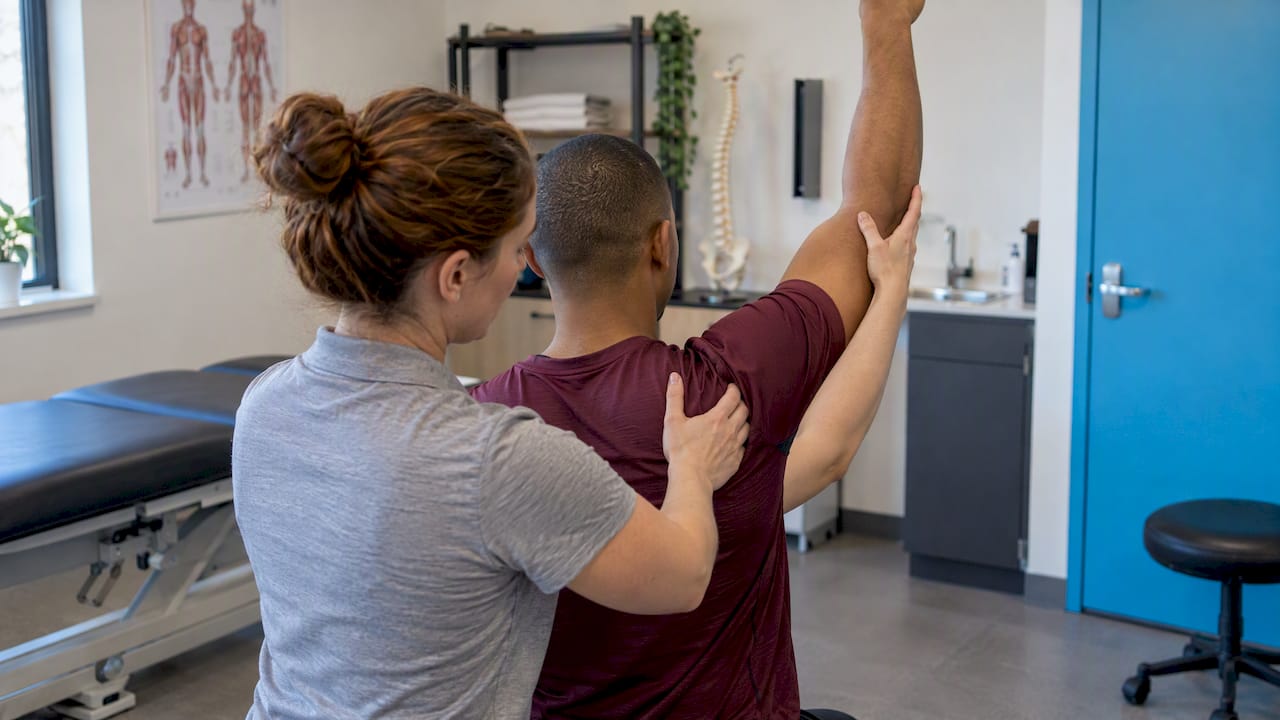
Other tools exist too. The Bunkie test is designed to detect restrictions across fascial lines of the kinetic chain, and the closed kinetic chain upper extremity stability test looks at shoulder performance and scapular stability.
In practice, here is what you can expect from a thorough visit:
- History. When the pain started, what makes it better or worse, past injuries, your sport, job, and daily positions.
- Observation. Posture, how you stand, walk, squat, reach, or perform the movement that hurts.
- Hands-on exam. Palpation of tissue, joint motion, and muscle tone, looking for restriction or tenderness away from the main complaint.
- Strength and control tests. Single-leg balance, core endurance, shoulder blade control, and side-to-side comparison.
- Referral or imaging if indicated. Used when the history or findings suggest something beyond a soft tissue or mechanical problem.
Our pages on shoulder impingement and rotator cuff tendinopathy show how this kind of assessment plays out in two common shoulder problems.
What an assessment can and cannot tell you
A fair assessment has limits, and you should hear them upfront. The Merck Manual describes pain evaluation as looking at the cause, severity, and nature of pain and its effects on activity, mood, cognition, sleep, and function, with history and physical exam guiding any lab or imaging studies.
But a peer-reviewed review of chronic pain assessment notes there is no direct linear relationship between detectable pathology and reported pain. People can have severe pain without identifiable pathology, and structural abnormalities without pain. Another review reports that the exact cause cannot be identified in roughly 85% of patients with back pain. The Texas Department of Insurance’s guidance for examiners also stresses that an exam or imaging finding alone does not prove causation; diagnosis comes from correlating mechanism, symptom timing, imaging, and exam findings.
What that means for you:
- A movement finding, such as a weak hip or a stiff ankle, is a lead, not a verdict.
- The test of a chain-based explanation is whether changing the suspected link changes your symptoms and function over time.
- Pain that is severe, getting worse, follows an injury or fall, comes with numbness or weakness, fever, or unexplained weight loss needs a medical evaluation first. See a physician promptly for those.
A comprehensive chronic pain assessment also looks beyond tissues. It combines history, medical evaluation, and screening of biomedical, psychosocial, and behavioral factors, which helps decide what needs further evaluation.
How rehabilitation addresses kinetic chain dysfunction
The research on shoulder rehab gives a useful model that applies broadly. Early rehab typically uses closed-chain exercises to re-establish proximal stability and control, while open-chain exercises generate greater loads and come later. Later stages add glenohumeral strengthening with open-chain work that isolates the rotator cuff.
A second review says effective rehab uses a comprehensive progression addressing proximal kinetic chain deficits, flexibility, and muscular performance rather than treating muscles in isolation. It describes muscular performance work in three phases: active conscious muscle control, functional daily activities, and advanced sport-specific performance.
Translated into a plan, that looks like this:
- Calm the irritated tissue and restore motion where it is restricted.
- Rebuild control at the base: core, hips, shoulder blades, or foot and ankle, depending on the chain.
- Reintegrate the movement so the links work together in squats, reaching, lifting, running, or throwing.
- Load it to your demands: your sport, your job, carrying a toddler.
This is why stretching alone often disappoints. If the problem is a link that is weak or poorly controlled, stretching the painful area does not change the load pattern. Our page on muscle activation therapy explains one approach to that gap.
Our perspective: treat the pattern, not just the sore spot
We see many patients who have already tried the standard routes. They rested, stretched, did exercises from a handout, and the pain came back. Our view is that persistent cases usually involve more than one tissue and more than one region, so we look at how you move and where tissue is restricted, not only where it hurts.
We use hands-on methods, including the Fascial Distortion Model, and pair them with an individualized plan. Hands-on work can reduce pain and open up motion, but we are honest that the effect lasts when it is paired with rehab that changes how you load the area. That is why our fascia work and myofascial release pages describe manual therapy as a way to aid rehab, not replace it.
We also tell patients when a finding is a lead rather than a certainty. Assessment narrows possibilities. How you respond to the first few visits tells us whether we are on the right track, and we adjust.
— Chris
How we approach it at The Tx Room in Plano
The Tx Room is a specialized chiropractic center in Plano, Texas, focused on musculoskeletal injuries and biomechanical imbalances. We treat athletes and non-athletes, including people with sciatica, plantar fasciitis, repetitive strain, posture problems, and sports injuries. Our care is hands-on and built around the Fascial Distortion Model, with individualized rehabilitation plans.
Depending on what your assessment shows, your plan may also include dry needling, MyACT focused shockwave, or deep tissue laser therapy. If your pain has not improved with standard medical or physical therapy approaches, that is a case we are set up to look at closely.

If a pain keeps coming back and you suspect it starts somewhere else, book an evaluation at our Plano chiropractic clinic and we will look at the whole chain with you.
When to get a professional evaluation
Self-care is reasonable for a short, mild flare. Our guidance on fascia pain suggests two to three weeks of self care, then hands-on help if it has not settled. Consider booking sooner if:
- The same area has hurt repeatedly over months.
- You changed how you move to avoid pain, and now a second area hurts.
- Pain limits training, work, sleep, or caring for your family.
- You have shoulder trouble. Our pages on shoulder pain and shoulder blade pain explain what to look for.
Go to urgent or emergency care for chest pain, sudden weakness, loss of bladder or bowel control, or severe pain after trauma. Those are not chain problems to work on in a clinic visit.
FAQ
What is kinetic chain dysfunction in simple terms?
It means one link in your connected system of joints and muscles is stiff, weak, unstable, or poorly controlled, so other areas pick up the slack. Over time, those areas can become painful or injured. The sore area is not always the source.
What is a kinetic chain assessment?
It is a clinical evaluation of how your body moves as a whole. It usually includes your history, observation of movements, hands-on exam, strength and mobility tests, and imaging when needed. It gives your clinician leads about which links to treat, though it cannot always pin pain to a single cause.
Is a squat a closed kinetic chain exercise?
Yes. In a squat your feet stay planted, and the ankle, knee, and hip move together in a coupled way. An arm curl or leg curl is an open-chain example, where one joint moves independently.
Why do I keep getting injured?
Often it is compensation. After a prior injury, tight or weak areas can change the forces on other tissues and make further injury more likely. A movement assessment can help find the pattern, and a professional should rule out other medical causes if pain is persistent or worsening.
Can hands-on therapy fix kinetic chain problems?
It can reduce pain and restore motion, which makes it easier to retrain movement. Lasting change usually needs a rehab component that rebuilds control and strength in the weak or stiff links. Your results depend on your condition, and your clinician should adjust the plan based on how you respond.
Sources
- Kinetic Chain Rehabilitation: A Theoretical Framework
- A regional interdependence model of musculoskeletal dysfunction
- CSM 2027 Pre-Conference: Head-to-Toe Rehabilitation (APTA Pelvic Health)
- Functional Fitness, Harvard Health
- Kinematic and Kinetic Chains, NSCA
- Evaluation and Management of Scapular Dyskinesis
- Role of kinetic chain in sports performance and injury
- Evaluation of Pain, Merck Manual Professional
- Assessment of patients with chronic pain
- Designated Doctor Musculoskeletal Physical Examinations, Texas Department of Insurance
- An Overview of the Management of Persistent Musculoskeletal Pain
- Scapular Dyskinesis and the Kinetic Chain