
High Arches Pain: Causes, Treatment and When to Get Help
High arches hurt because the foot stops spreading load the way it should. Weight lands on the heel and the ball of the foot instead of across the whole sole. The foot also tends to roll outward, so the ankle and the outer leg work harder to keep you steady. Relief usually comes from three things: finding out whether the foot is flexible or rigid, using support designed for a high arch (not a generic arch cushion), and treating the tight, overloaded tissue above it.
This guide covers why high arches hurt, what tends to help, which signs mean you should be examined sooner rather than later, and what hands-on care looks like in our Plano clinic.
TL;DR
- A high arch is often a normal foot shape. It becomes a problem when it causes pain, ankle rolling or calluses under the heel and ball of the foot.
- Standard drugstore arch supports can make a high arch worse, because they push the foot further outward. Orthoses with outer-edge support work differently.
- Custom-made orthoses have the best trial evidence for painful high arches, and soft tissue work and strengthening cover the muscles and fascia around them.
- Pain in only one foot, or a high arch that keeps changing with age, needs a prompt clinical evaluation to rule out a nerve or muscle cause.
- Heel pain, forefoot pain and outer-ankle pain each point to different tissues, so where it hurts is the best clue to start with.
Table of Contents
- What counts as a high arch
- Why high arches cause pain
- Which pain points to what
- What helps: the evidence on orthoses
- Self-care that is worth your time
- When high arches need a medical evaluation
- Our perspective on high arches
- What hands-on care looks like in Plano
- Choosing the right kind of help
- FAQ
- Sources
What counts as a high arch
Clinicians call a markedly high arch pes cavus. StatPearls describes it as an elevated longitudinal arch that appears in both children and adults. A review of cavus foot reconstruction notes it covers a wide spectrum of foot shapes and often comes with an inward-tilting heel (hindfoot varus).
That spectrum matters. Scotland’s NHS Lothian referral guidance says a high-arched foot is a normal variant that usually needs no treatment, though some cases are pathological and warrant investigation. So having high arches is not a diagnosis. Having high arches and pain, instability or progressive change is the situation worth acting on.
A quick look at your own feet can help:
- Wet footprint test: step onto dry concrete with a wet foot. If the print shows little or nothing between heel and ball, your arch is high.
- Shoe wear: shoes that wear down on the outer edge of the heel and forefoot suggest the foot rolls outward.
- Skin: calluses under the ball of the foot, the outer edge or the heel mean pressure is concentrated there.
- Toes: clawed or hammered toes often accompany a high arch.
A footprint is only a screen. It cannot tell you whether the foot is flexible or rigid, which is the question that decides treatment.
Why high arches cause pain
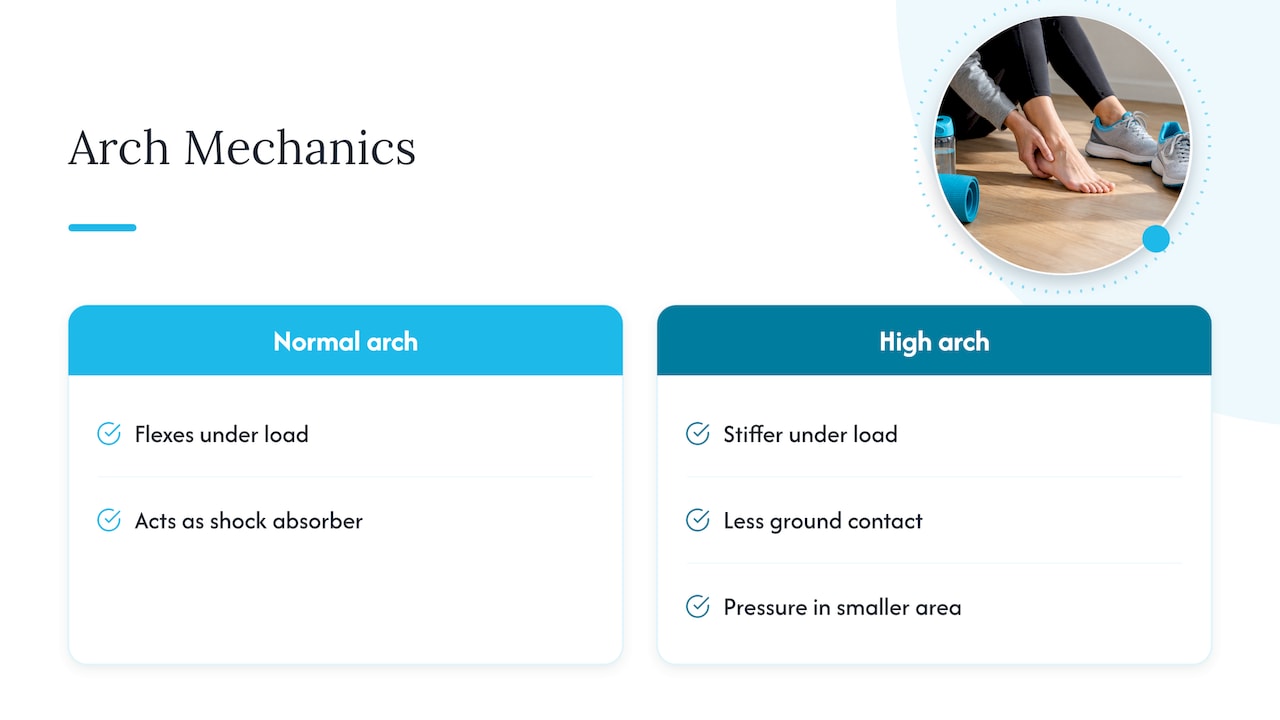
A normal arch flexes under load and acts as a shock absorber. A high arch is stiffer and has less contact with the ground, so the pressure goes into a smaller area. Cleveland Clinic says very high arches can cause pain and instability when you walk and may change the foot over time.
In practice, the pain shows up in a few predictable places.
Heel and arch: plantar fascia strain
The plantar fascia is the band of tissue running from heel to toes. In a high arch it is held on stretch, and it takes repeated tension with every step. The classic result is sharp heel pain with the first steps in the morning. If that sounds like you, read our guide on chiropractic care for plantar fasciitis with home loading.
Ball of the foot: metatarsalgia and plate irritation
With less midfoot contact, the forefoot absorbs more force. That can show up as burning or bruise-like pain under the toe joints, calluses, or a sore spot at the base of one toe. A sore base of the second toe that swells or drifts can involve the ligament under the joint, covered in our page on plantar plate tear treatment before surgery.
Outer ankle and foot: instability and tendon overload
A foot that rolls outward loads the outside of the ankle. People describe it as the ankle “giving way” on uneven ground, repeated sprains, or an aching outer shin and ankle. The peroneal tendons run along that outer edge and work overtime to hold the foot steady. If this is your pattern, see our exercise-first approach to peroneal tendonitis. The mechanics behind it are covered on our page about supination and orthoses.
Further up the chain
A stiff, outward-rolling foot does not absorb shock well, so shins, knees, hips and low back can take up the slack. Pain in those areas that never fully settles can have its origin at the foot.
Which pain points to what
| Where it hurts | Common tissue involved | Typical clue |
|---|---|---|
| Heel, first steps in the morning | Plantar fascia | Eases after a few minutes, returns after sitting |
| Under the ball of the foot | Metatarsal heads, forefoot fat pad, plantar plate | Calluses, burning, worse in thin-soled shoes |
| Outer ankle | Peroneal tendons, lateral ligaments | Rolling the ankle, aching on slopes |
| Mid-arch | Fascia and small foot muscles | Tight, cramping feeling after standing |
| Outer edge of the foot | Overloaded lateral foot structures | Pain along the outside during long walks or runs |
| Shins, knees, hips | Compensation up the chain | Pain that does not settle with local treatment |
If you want a broader map, our foot pain location guide walks through causes by area and what to try at home for one to two weeks.
What helps: the evidence on orthoses
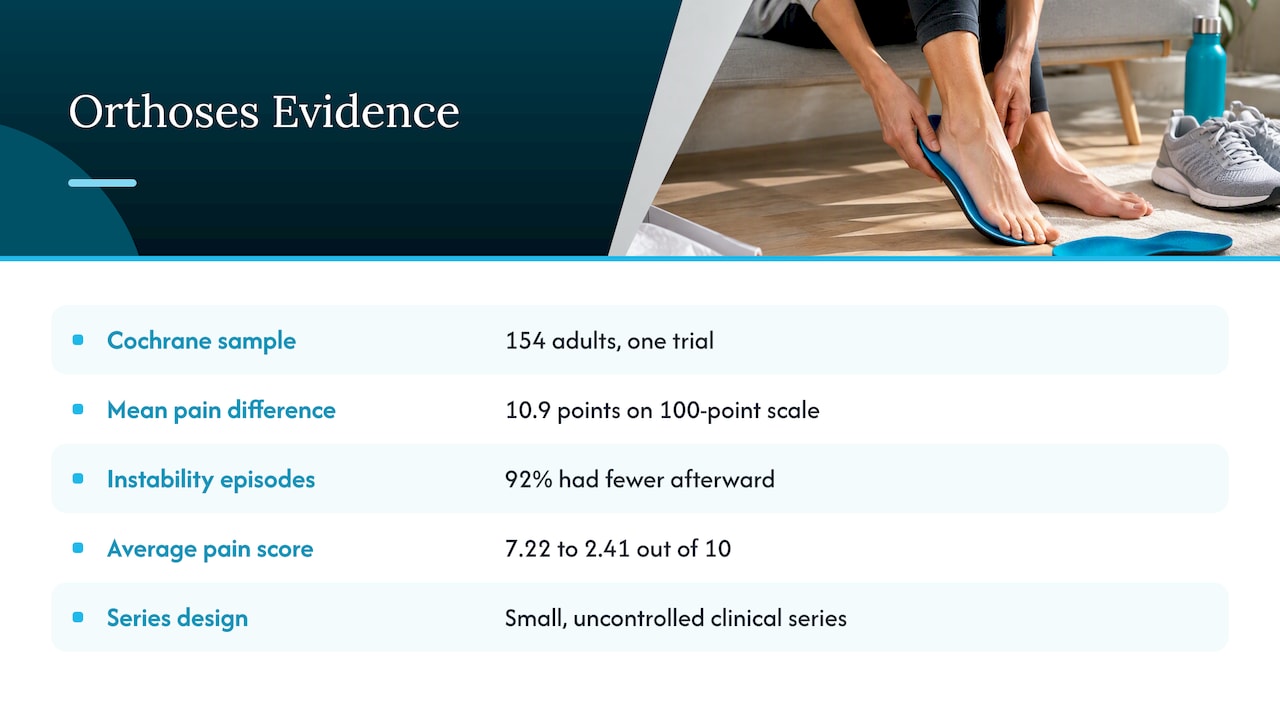
The strongest evidence for painful high arches is for custom-made foot orthoses. A Cochrane review found that custom-made orthoses were significantly more beneficial than sham orthoses for foot pain linked to pes cavus. It was based on one trial of 154 adults that met the inclusion criteria. The trial results showed a mean pain difference of 10.9 points on a 100-point scale in favor of custom devices. That is a real but modest difference, which is a fair reminder that orthoses are one part of the plan.
A separate study of a custom cavus foot orthosis in people with ankle instability and pain reported that 92% had fewer instability episodes afterward, and average pain scores fell from 7.22 to 2.41 out of 10. It was a smaller, uncontrolled clinical series, so treat it as encouraging rather than proof.
Why the usual arch support can backfire
Most over-the-counter insoles add height under the inner arch. For a flat foot, that makes sense. For a foot that already rolls outward, research on how orthoses work in the cavus foot points to a different goal: redistributing pressure and supporting the outer side of the foot. Padding under an already high inner arch can push the foot further into supination.
What tends to work better in a well-designed device:
- Outer-edge (lateral) support so the foot is not tipped outward.
- Cushioning relief around the metatarsal heads so the ball of the foot takes less peak pressure.
- Full contact under the arch to spread load, rather than a hard bump.
That is why a cushioned generic insole can feel good for a day and then leave you no better. If you try a drugstore insole, give it a short trial and stop if the outer ankle or foot gets sorer.
The flexible versus rigid question
Clinicians commonly use the Coleman block test to judge whether the heel’s inward tilt is flexible or rigid. A flexible foot can often be realigned with non-surgical orthoses. A rigid one may need a different plan. This is a hands-on assessment, and it is a good reason not to guess from a footprint.
Self-care that is worth your time
Home care will not change your bone structure, but it can reduce irritation while you sort out the cause.
- Check your shoes. Choose a shoe with a firm, wide base and enough cushioning at the heel and forefoot. Worn-out shoes lose their cushioning first where you need it.
- Load, don’t just stretch. Calf and foot muscles tend to be tight in high arches, but stretching alone often does not settle the problem. Gradual strengthening for the calf, the small foot muscles and the outer ankle is usually more useful. Our article on why stretching alone falls short explains how muscles can be retrained.
- Calf and plantar release. Gentle rolling on the sole and calf can ease tightness. Keep it comfortable, not painful.
- Balance work. Standing on one leg, then on a softer surface, trains the ankle to cope with the instability a high arch invites.
- Change load gradually. Add running distance or standing hours in small steps, not all at once.
Give this a couple of weeks. If pain is clearly improving, continue. If it is flat or worse, the foot needs a proper exam.
When high arches need a medical evaluation
Most people with high arches have nothing more serious than a mechanical problem. A few patterns deserve prompt attention.
- Only one foot has a high arch. NHS Lothian’s guidance flags one-sided high arches as a reason to look for an underlying cause.
- The arch is getting higher over time, or you notice your foot shape changing as you age.
- New weakness, tripping, foot drop or loss of feeling. See your primary care doctor or a neurologist.
- Frequent ankle sprains with no clear injury.
- Pain in a child with a high arch. A review on managing pes cavus in children says high arches in childhood are often a harmless variant, but some forms can be linked to a neurological cause and merit evaluation.
The same sources tie some cases of high arches to nerve and muscle conditions such as Charcot-Marie-Tooth disease. That is not the usual explanation, but it is the reason a one-sided or progressing high arch should not simply be padded with an insole.
Our perspective on high arches
We see high arches differently from how most shoe stores do. A high arch is not a flaw to be filled with foam. It is a foot that has lost some of its shock absorption, so the tissue above it takes more strain: the plantar fascia, the peroneal tendons, the calf and often the hip.
So we start with a hands-on assessment, not a product. We look at how the foot loads, how the ankle moves, where the soft tissue is restricted and whether the pattern looks like an ordinary mechanical problem or something that should go to another specialist. If it needs a neurologist or an orthopedic foot specialist, we say so.
When it is mechanical, we treat the tissue that is working too hard. Our approach is built on the Fascial Distortion Model, a hands-on method for soft tissue injuries, along with myotherapy and an individualized rehab plan. We pay particular attention to people who have already tried standard care, such as an insole, rest or a round of stretching, and are still hurting. The aim is to restore how the foot and leg move so that you can return to your sport, your job or your day with kids without pain setting the pace.
We will also be straight with you about limits. Hands-on work does not reshape a bony arch. Where a custom orthosis is the right answer, we will recommend that you get one, and we will pair it with the soft tissue and strengthening work that helps it succeed.
— Chris
What hands-on care looks like in Plano
If high arch pain is limiting your running, work or time on your feet, our Plano clinic offers several tools, chosen to fit what the exam finds:
- Chiropractic care and soft tissue therapy for joints and muscles that have taken on extra load.
- Fascial Distortion Model treatment for soft tissue injuries and tight fascia.
- Dry needling for stubborn calf, foot and lower leg trigger points.
- MyACT focused shockwave and deep tissue laser therapy for persistent soft tissue pain.
We accept both self-pay and insurance. Start with an initial exam and we will tell you what we find, what we would treat and what, if anything, should be handled elsewhere. You can book as a new patient through our site.
Choosing the right kind of help
The different professionals who treat high arch pain do different jobs, and the best outcomes often combine them.
| Type of care | What it does well | Limit |
|---|---|---|
| Custom orthosis from a foot specialist | Redistributes pressure, supports the outer foot | Does not release tight tissue by itself |
| Hands-on soft tissue care and rehab | Treats fascia, muscles and tendons that are overloaded | Does not change bone shape |
| Neurologist or orthopedic foot specialist | Investigates nerve causes, rigid deformity, surgery questions | Usually not first-line for ordinary mechanical pain |
| Generic drugstore insoles | Cheap short-term cushioning | Often lack outer-edge support, may worsen supination |
A sensible path for most adults is: a hands-on exam, a short trial of treatment and rehab, and an orthosis if the findings call for one. Move to a specialist sooner if you have any of the warning signs above.
FAQ
Are high arches bad for you?
Not necessarily. A high arch is often a normal variation and needs no treatment if it does not cause symptoms. It becomes a concern when it brings pain, frequent ankle sprains, calluses, or when it appears in only one foot or keeps changing.
What is the best treatment for painful high arches?
The best-studied option is custom-made foot orthoses, which a Cochrane review found more beneficial than sham devices for pain. Soft tissue treatment, strengthening and better footwear usually round out the plan. The right mix depends on whether your foot is flexible or rigid and where it hurts.
Do arch supports help high arches?
Only if they are designed for a high arch. Standard inner-arch supports can push an outward-rolling foot further into supination. Look for outer-edge support and relief under the ball of the foot, ideally prescribed after an assessment.
What exercises help high arch foot pain?
Gradual calf strengthening, small foot muscle work, outer-ankle strengthening and single-leg balance drills are common starting points. Gentle calf and sole release can ease tightness. Stop any exercise that sharpens the pain, and get examined if you see no change after a couple of weeks.
When should I see someone about high arches?
See a clinician if only one foot has a high arch, if the arch is changing, or if you notice weakness, tripping or numbness. Those signs call for evaluation by a medical doctor or neurologist before you rely on insoles or home care. Pain that lingers beyond a couple of weeks also deserves an exam.
Sources
- Pes Cavus, StatPearls (NCBI Bookshelf)
- Reconstruction of Cavus Foot: A Review (PMC)
- Pes cavus (high arched foot), NHS Lothian RefHelp
- High Arch Feet (Pes Cavus), Cleveland Clinic
- Interventions for pes cavus, Cochrane
- Interventions for the prevention and treatment of pes cavus, PubMed
- Effectiveness of the cavus foot orthosis, PubMed
- Mechanism of orthotic therapy for the painful cavus foot deformity, PMC
- Coleman block test reference, PubMed
- How to manage pes cavus in children and adolescents, PMC