
Chiropractic for Tennis Elbow: What It Does and When to Go
Chiropractic care for tennis elbow is hands-on treatment of the forearm, elbow, wrist and often the neck and upper back, paired with a progressive exercise plan. The goal is to calm the irritated tendon, restore normal movement and get you gripping, lifting and swinging again. It works best when the manual work is combined with graded strengthening, not used alone. If you are in Plano and your outer elbow still hurts when you lift a coffee cup, this guide explains what a visit involves and what to expect.
TL;DR
- Tennis elbow (lateral epicondylitis) is a tendon problem on the outside of the elbow, and it responds best to manual therapy combined with progressive loading exercises.
- Research on manual therapy is encouraging but not conclusive. Its main value is short-term pain relief that lets you do the strengthening that drives recovery.
- Most cases improve with conservative care, often within three months. Pain that is not improving by 12 to 24 weeks needs a medical referral.
- Swelling, lumps, a significant injury or pain in several joints calls for a medical evaluation first.
- At The Tx Room, we treat the elbow with hands-on soft tissue work and the Fascial Distortion Model, then build a rehab plan around your job or sport.
Table of Contents
- What tennis elbow actually is
- What a chiropractor can do for tennis elbow
- What the evidence honestly says
- What recovery usually looks like
- Keep training without feeding the pain
- When to see a doctor first
- Treatment at The Tx Room in Plano
- Tips to help the treatment hold
- FAQ
- Sources
What tennis elbow actually is
Despite the name, you do not need to play tennis. Mayo Clinic describes tennis elbow as pain where the forearm tendons attach to a bony bump on the outside of the elbow. The pain can spread down into the forearm and wrist. Tiny tears and long-standing swelling can cause the tendon to break down, and repeated tensing of the forearm muscles can trigger symptoms, though the exact cause is not well understood.
In daily life, this looks like:
- Pain or weakness when you grip, such as holding a coffee cup or shaking hands
- Trouble turning a doorknob
- An ache on the outer elbow after typing, mousing, painting, or using hand tools
- Soreness after racquet sports, climbing or weight training
The people we see with it are often not athletes at all. Desk workers, electricians, hairstylists, parents lifting toddlers and anyone with repetitive hand tasks all show up. That matters, because the treatment plan has to account for the load that keeps irritating the tendon, not only the elbow itself.
What a chiropractor can do for tennis elbow
Tennis elbow is a tendon and soft tissue problem, so the most useful chiropractic care is not just a quick adjustment of the elbow. A thorough visit typically includes several pieces.
Assessment of the whole arm and neck
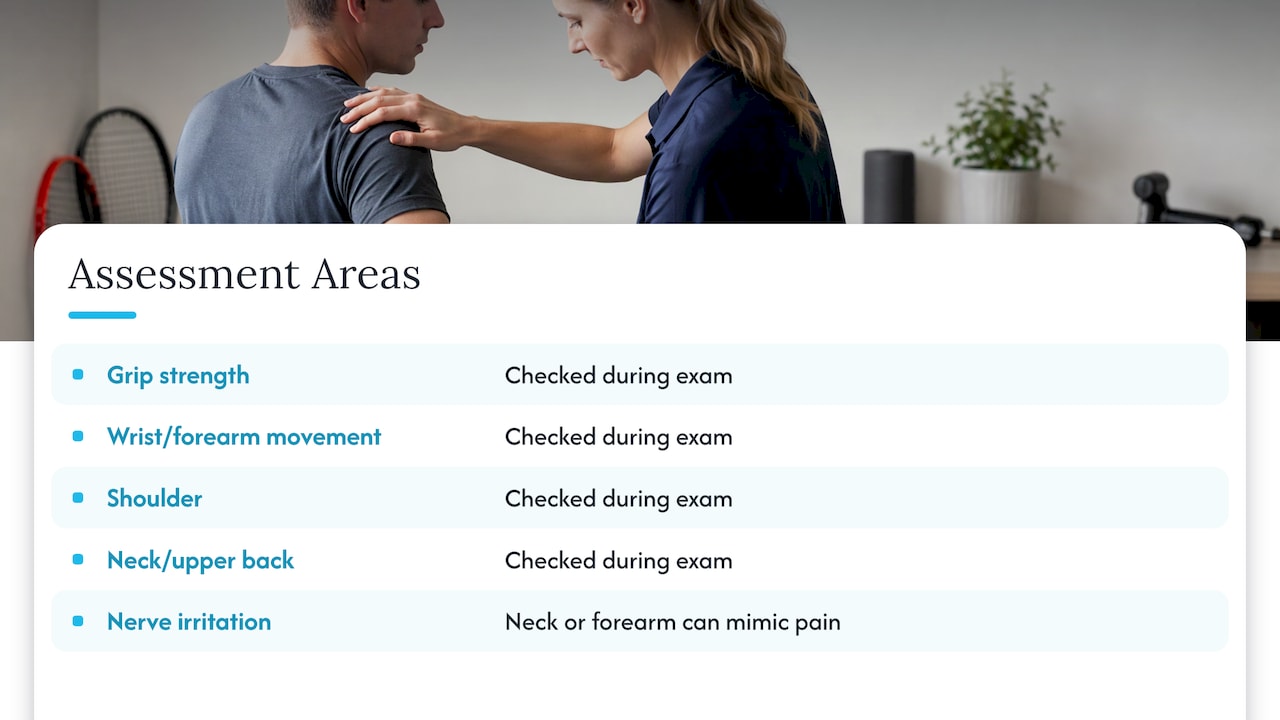
The pain is on the elbow, but the cause is often upstream or downstream. A good exam checks grip strength, wrist and forearm movement, the shoulder, and the neck and upper back. Nerve irritation in the neck or at the forearm can mimic or add to tennis elbow, so ruling in or out the true source comes first.
Joint mobilization and manipulation
Gentle mobilization of the elbow, wrist and forearm joints is common. Some clinicians also treat the cervical and thoracic spine. A review of exercise therapy and mobilization found moderate evidence for short-term benefit from stretching plus strengthening compared with ultrasound plus friction massage. It also found moderate evidence for short- and mid-term benefit when cervical and thoracic manipulation was added to stretching and wrist and forearm mobilization. The authors noted the results were not conclusive, and that the main value of manipulation is short-term pain relief that makes more vigorous stretching and strengthening possible.
That last point shapes how we use it. Manual work opens the door, and exercise gets you through it.
Soft tissue therapy
The forearm extensor muscles are usually tight, tender and full of trigger points. Hands-on soft tissue work aims to reduce that tension and improve how the muscle and its surrounding fascia glide. A Cochrane review reported that, compared with sham manual therapy, manual therapy for tennis elbow may reduce pain and disability at the end of treatment. It also reported that manual therapy, prescribed exercise, or both may reduce pain and disability slightly compared with minimal treatment.
Dry needling
A 2024 multicenter randomized clinical trial found that adding electrical dry needling and thrust manipulation to multimodal physical therapy produced significantly greater improvements in pain and disability at 3 months than therapy alone. We offer dry needling for stubborn forearm trigger points and tendon pain that is not settling with manual work alone.
Focused shockwave and other tools
A 2022 review of physiotherapy treatment of lateral epicondylitis found that manual therapy and eccentric strength training had the greatest beneficial effects and a favorable cost-benefit ratio. It noted that techniques such as shock waves and taping may help reach therapeutic goals. That is why we treat them as additions to a plan built on hands-on work and loading, used when the case calls for it. Our MyACT focused shockwave and deep tissue laser therapy fit here.
A loading program
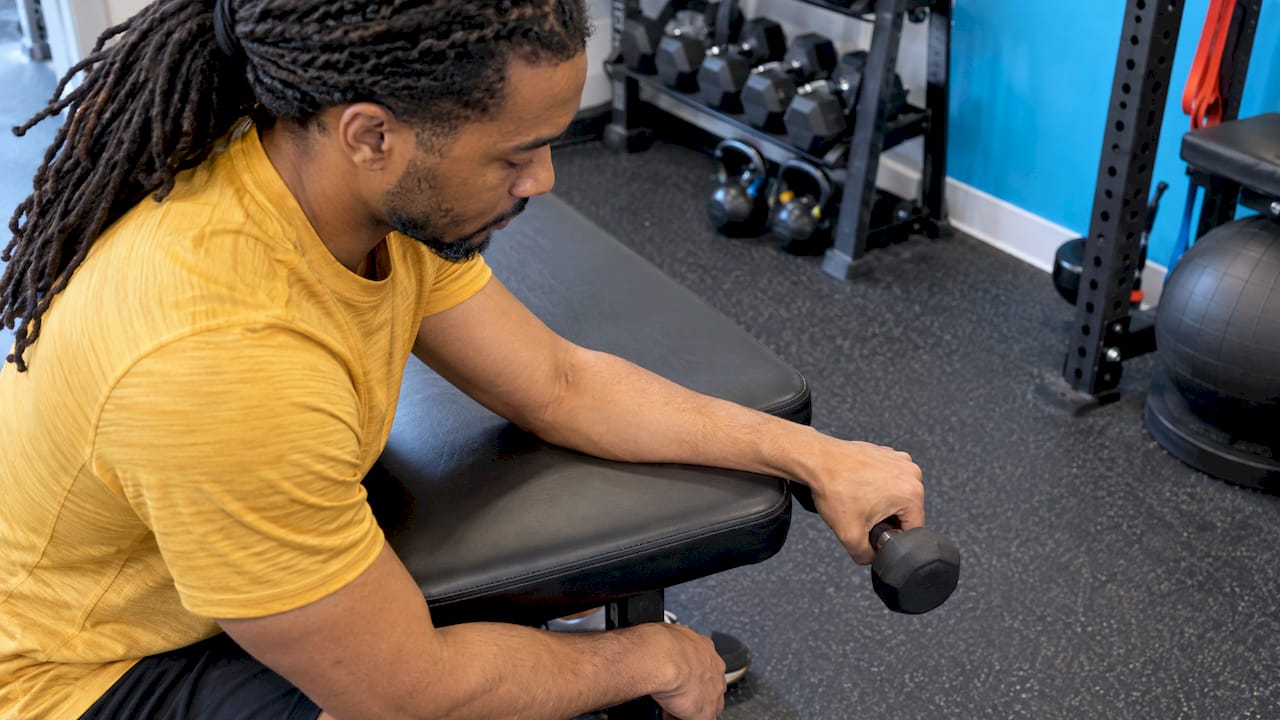
This is the part that decides long-term results. The Canadian Chiropractic Guidelines describe progressive, graded loading (isometric, concentric and eccentric exercise) as the cornerstone of successful long-term rehabilitation. Any chiropractor who treats your elbow and sends you home without exercises is giving you half a plan.
What the evidence honestly says
Here is where the research stands, so you can set realistic expectations.
| Approach | What the research suggests |
|---|---|
| Manual therapy alone | May reduce pain and disability, mostly in the short term |
| Manual therapy plus exercise | Better supported than either idea in isolation, with a favorable cost-benefit ratio |
| Cervical and thoracic manipulation added to local care | Moderate evidence for short- and mid-term benefit, not conclusive |
| Dry needling plus manipulation added to multimodal therapy | Greater improvement in pain and disability at 3 months in one 2024 trial |
| Progressive loading | Considered the cornerstone of long-term rehab |
Two further points help. First, a guideline from the British Elbow and Shoulder Society reports that physiotherapy improves overall outcomes in the short term with no difference in the medium or long term, and that long-term evidence is low certainty. In practical terms, no single hands-on technique has been proven to change the long game by itself. What you want is relief early, then loading that rebuilds the tendon.
Second, medical experts note that tennis elbow is a spectrum of tendon pathology, and inconsistent trial results may come from treating everyone as one group instead of grading how far the tendon has broken down. This is the argument for individualized care: a flare-up two weeks old and a stubborn elbow of nine months are not the same problem and should not get the same plan.
What recovery usually looks like
The same BESS pathway says most symptoms respond within three months, and most patients improve significantly within 3 to 18 months with conservative management. That range is wide because tendons heal slowly and because the load that caused the problem often continues.
A typical progression looks like this:
- Calm it down. Reduce the aggravating tasks without stopping everything. The pathway lists activity modification, modified lifting and, for some people, topical or oral NSAIDs for up to four weeks. A 2018 review describes relative offloading: identify the work or sport factors driving the pain, then reduce load and give the tendon more recovery time.
- Treat the tissue. Manual therapy, soft tissue work and, where appropriate, needling or shockwave to lower pain and restore movement.
- Load the tendon. Start with gentle isometric holds, then add concentric and eccentric work, building resistance as pain allows.
- Return to full activity. Grip, lift and swing in stages, and adjust technique, equipment or workstation so the problem does not return.
The BESS pathway also notes that orthotics may not provide benefit, so a brace is not a substitute for a rehab plan.
What about compressing it?
People often ask whether to compress tennis elbow. The research we reviewed does not recommend compression as a core treatment. The measures that are supported are activity modification, stretching and eccentric loading. If a strap or sleeve makes daily tasks more comfortable, it is fine as a short-term aid, but it should sit alongside exercise, not replace it.
Keep training without feeding the pain
You do not have to stop moving. Grip-heavy and wrist-loaded work is the usual trigger, so it helps to see how others adapt training when the wrist or forearm complains. This push-up rehab plan for wrist pain shows one way to adjust load and progress gradually, which is the same principle that guides elbow rehab. Whatever you choose, keep pain tolerable during and after, and back off if the outer elbow flares for more than a day.
When to see a doctor first
Conservative care is appropriate for most tennis elbow, but not all elbow pain is tennis elbow. The BESS guideline lists red flags that need urgent referral:
- An injury likely to have caused a fracture or dislocation
- Swelling or lumps around the elbow
- Inflammation involving multiple joints
- Any suspicion of a tumor
The same guideline says that when persistent pain has not improved within 12 to 24 weeks, you should be referred to secondary care for further evaluation. If you have gone three months or more with proper rest and rehab and the elbow is not better, ask for imaging or a specialist opinion rather than waiting longer. A responsible chiropractor will tell you the same.
We also look for other causes of outer elbow pain. Pain deeper in the forearm that does not match tendon tenderness can point to nerve involvement, which we cover in our guide on radial tunnel syndrome. If the pain is on the inner elbow instead, that is golfer’s elbow.
Our perspective
Tennis elbow rarely needs one clever trick. It needs the right order of operations. We start by working out what is actually driving the pain: the extensor tendon, tight forearm fascia, a stiff neck or upper back, or the way you use your hand all day.
Then we use our hands. The Fascial Distortion Model gives us a structured way to find and treat distortions in the connective tissue around the elbow and forearm, and we pair it with soft tissue work and, when needed, dry needling or focused shockwave. The point is fast, honest progress: less pain so you can start loading the tendon sooner.
We focus on people whose elbows have not improved with standard approaches. For them, a custom plan that treats the tissue and then builds strength around their job, sport or parenting routine is what gets them back to their lives.
Chris
Treatment at The Tx Room in Plano
Our Plano clinic specializes in hands-on care for musculoskeletal and soft tissue injuries. For tennis elbow, your plan may combine chiropractic care and soft tissue therapy, the Fascial Distortion Model, dry needling and a progressive loading program. We accept insurance and self-pay patients. Read our full guide on how to treat tennis elbow or see our page on tennis and golfer’s elbow in Plano.
If your elbow pain has lingered past a few weeks, book an exam at The Tx Room and we will tell you what is driving it and what the next step should be.
Tips to help the treatment hold
- Change the load, not just the rest. Use a larger-grip handle on tools, keep wrists neutral when typing, and carry bags close to the body with a palm-up grip.
- Strengthen on a schedule. Short daily sessions of isometric and eccentric wrist extension beat occasional long ones.
- Do not ignore the neck and upper back. If they are stiff, they may be part of why the arm is overloaded.
- Track your response. Note what you can do without pain: gripping a mug, opening a jar, a full workday at the keyboard. Progress shows up in function before it shows up in pain scores.
- Check in early. Persistent pain at six to eight weeks is a reason to adjust the plan, not to wait it out.
For a gentler approach to early flare-ups, our guide on elbow pain home care explains what to try over the first one to two weeks before hands-on treatment.
FAQ
Can a chiropractor help tennis elbow?
Yes, as part of a broader plan. Manual therapy may reduce pain and disability, and it makes strengthening exercises easier to do. Research is encouraging but not conclusive, so results depend on combining hands-on care with progressive loading.
How many visits does tennis elbow take to improve?
It varies with how long you have had it and how irritated the tendon is. Guidelines say most symptoms respond within three months, and significant improvement can take 3 to 18 months with conservative care. Your clinician should reassess often and change the plan if you are not progressing.
Is chiropractic care for tennis elbow safe?
For most people with a typical tendon problem, gentle manual therapy and graded exercise are appropriate. See a medical provider first if you have swelling, lumps, a significant injury, pain in several joints, or pain that has not improved by 12 to 24 weeks.
Should I rest or exercise tennis elbow?
Both, in the right proportions. Reduce the tasks that provoke it, but keep the tendon gently loaded. Guidelines call progressive isometric, concentric and eccentric exercise the cornerstone of long-term rehabilitation.
Sources
- Tennis elbow: Symptoms and causes, Mayo Clinic
- Exercise therapy and mobilisation for lateral epicondylalgia, review (2013)
- Manual therapy and exercise for treating tennis elbow, Cochrane
- Percutaneous tendon dry needling and thrust manipulation, randomized trial (2024)
- Physiotherapy treatment of lateral epicondylitis (2022)
- Epicondylitis, Canadian Chiropractic Guidelines
- BESS patient care pathway: Tennis elbow (2023)
- Lateral elbow tendinopathy: development of a classification (2016)
- Lateral elbow tendinosis: a review of diagnosis and management (2018)
- Keep Training With Wrist Pain: 8 Week Push Up Rehab Plan