
Chiropractic for Scar Tissue: What Hands-On Care Can Do
Chiropractic care approaches scar tissue with hands-on soft tissue work, guided movement and a rehab plan built around the area that feels tight, sticky or painful. Scar tissue forms after sprains, strains, tears and surgery. When it limits motion or hurts, a clinician trained in manual therapy can assess it, treat the surrounding tissue and show you how to keep the area moving. Below you will find the techniques involved, what published research says, how to stay safe, and what a first visit looks like at our Plano clinic.
TL;DR
- Scar tissue is the body’s repair material. It becomes a problem when it feels tight, tender or restricts movement in a joint or muscle.
- Chiropractic care for scars usually combines manual soft tissue work, movement and strengthening, rather than one single technique.
- Published research describes massage, instrument-assisted soft tissue mobilization (IASTM), soft tissue mobilization and nerve gliding as manual options, and notes that pressure should be controlled.
- Tell your clinician about surgery dates, open wounds, bone density issues, heart or circulation conditions, diabetes, pregnancy or blood-thinning medication before any treatment.
- At The Tx Room in Plano, we use the Fascial Distortion Model, myotherapy and individualized rehab plans for soft tissue problems.
Table of Contents
- What scar tissue is and why it can hurt
- How chiropractic care approaches scar tissue
- What the research says about IASTM
- Staying safe: who should tell us what first
- The Tx Room perspective
- Tools we use for soft tissue restrictions in Plano
- What a visit looks like
- Doing your part between visits
- Common situations we see
- Book an evaluation in Plano
- FAQ
- Sources
What scar tissue is and why it can hurt
When muscle, tendon, ligament, fascia or skin is damaged, the body repairs it with new tissue. That new tissue is the scar. It does its job, but it is not always identical to the tissue it replaced. Depending on where it forms, it can feel thicker, less stretchy or more sensitive than the structures around it.
People usually notice scar-related trouble in a few ways:
- A band or knot you can feel under the skin, often near an old injury or incision.
- Stiffness that returns each morning or after sitting, in an area you injured months or years ago.
- A pulling sensation when you reach, bend, squat or stride.
- Tenderness or tingling along or near a surgical scar.
- A movement pattern that has changed: you favor one side, and a different joint starts to ache.
That last point matters. A restricted area rarely stays isolated. The body works around it, and neighboring muscles and joints take extra load. This is why a scar from a past ankle sprain can show up as a hip or low back complaint years later. A good evaluation looks at the scar and at how you move around it.
The type of scar also shapes the plan. A 2022 narrative review of painful scars describes how presentation varies with body region, the cause (burn, postsurgical or traumatic), the depth and extent of the scar, and how long it has been there (acute, subacute or chronic). A six-week-old surgical incision is a different situation from a ten-year-old hamstring tear, and they are not handled the same way.
How chiropractic care approaches scar tissue
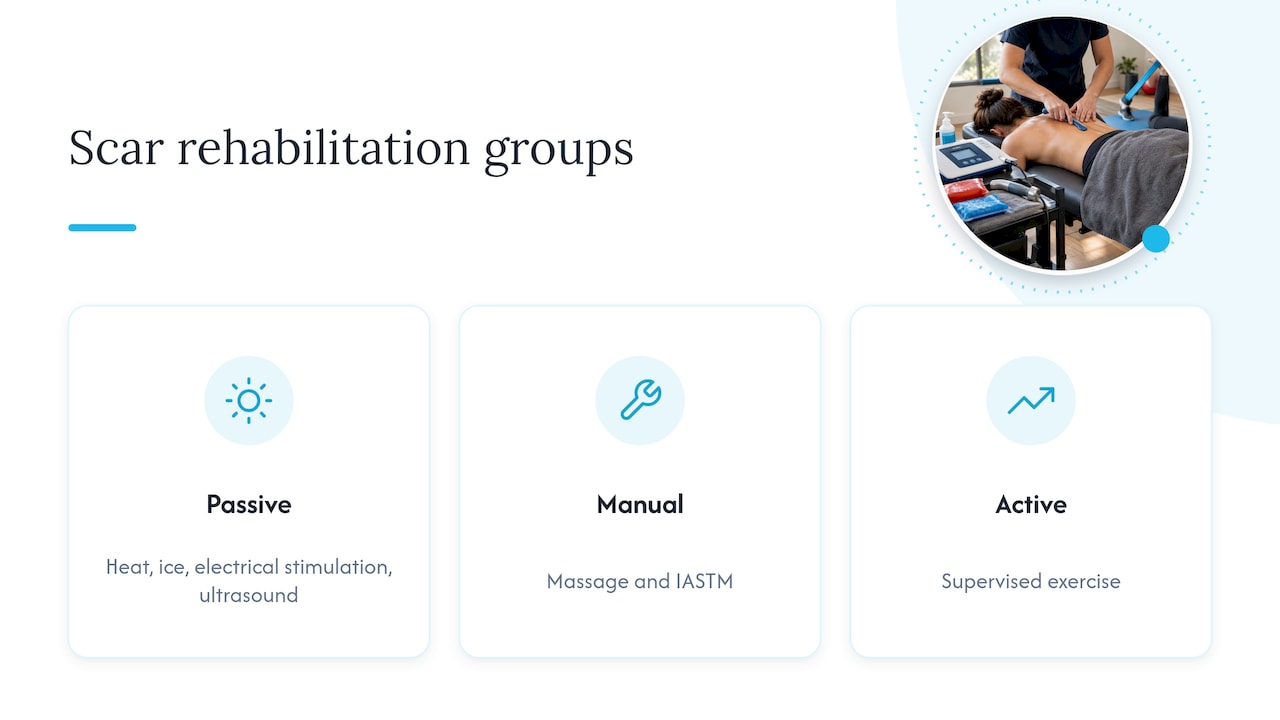
There is no single “scar tissue adjustment.” Chiropractic care for scars is a combination of assessment, hands-on soft tissue work, joint and movement work, and rehabilitation. The same review organizes painful-scar care in physical rehabilitation into three groups: passive modalities such as heat, ice, electrical stimulation and ultrasound, manual therapies such as massage and instrument-assisted soft tissue mobilization, and active motion-based therapies with supervised exercise. Chiropractic care draws on the same toolbox, and the best plans use more than one group.
Manual soft tissue work
This is the core of scar-focused care. Using hands, forearms or a handheld tool, the clinician applies pressure and movement to the scarred area and to the tissue around it. The aim is to improve how the layers glide, ease sensitivity and restore range of motion. Techniques you may hear named include:
- Massage and soft tissue mobilization: hands-on pressure and stretch applied along the direction of the restricted tissue.
- Instrument-assisted soft tissue mobilization (IASTM): a smooth-edged tool glides over the skin to find and work on restricted areas.
- Nerve gliding: gentle, controlled movements that help a nerve slide through the tissues around it, useful when a scar sits near a nerve path.
- Active motion techniques: you move the joint through a range while the clinician holds or guides the tissue, a method used in programs such as Active Release Treatment.
The review lists massage, IASTM, soft tissue mobilization and nerve gliding among the manual approaches used in rehabilitation for painful scars, and cautions that excessive traction or pressure may aggravate pain or disrupt healing. In practice, that means pressure should be graded to your tissue and your response, not pushed as hard as you can tolerate.
Fascia-focused methods
Scars rarely stay in one layer. They can involve the fascia, the connective tissue that wraps muscle and links one region to the next. That is where the Fascial Distortion Model comes in. FDM is a hands-on approach that treats soft tissue problems by identifying how the patient describes and points to the problem, then applying specific manual techniques. You can read more about how the Fascial Distortion Model works on our site. For related fascia work, see our page on fascia work paired with rehab and our overview of myofascial release.
Joint and movement work
Chiropractic adjustments address joint motion. When a scarred muscle or ligament limits a joint, the joint above or below often gets stiff too. Restoring movement at neighboring joints can reduce the load on the tender area and help you use the full range you gain from soft tissue work.
Exercise and movement retraining
Tissue responds to load. Once the area is moving better, strengthening and controlled stretching teach the body to use the new range. This is the part that keeps results in place, and it is why we pair manual work with a home plan. If your trouble is tied to a muscle that has stopped firing well, muscle activation therapy can be part of that retraining.
What the research says about IASTM
IASTM is the technique most often mentioned in search results for scar tissue, so it is worth knowing how it has been studied.
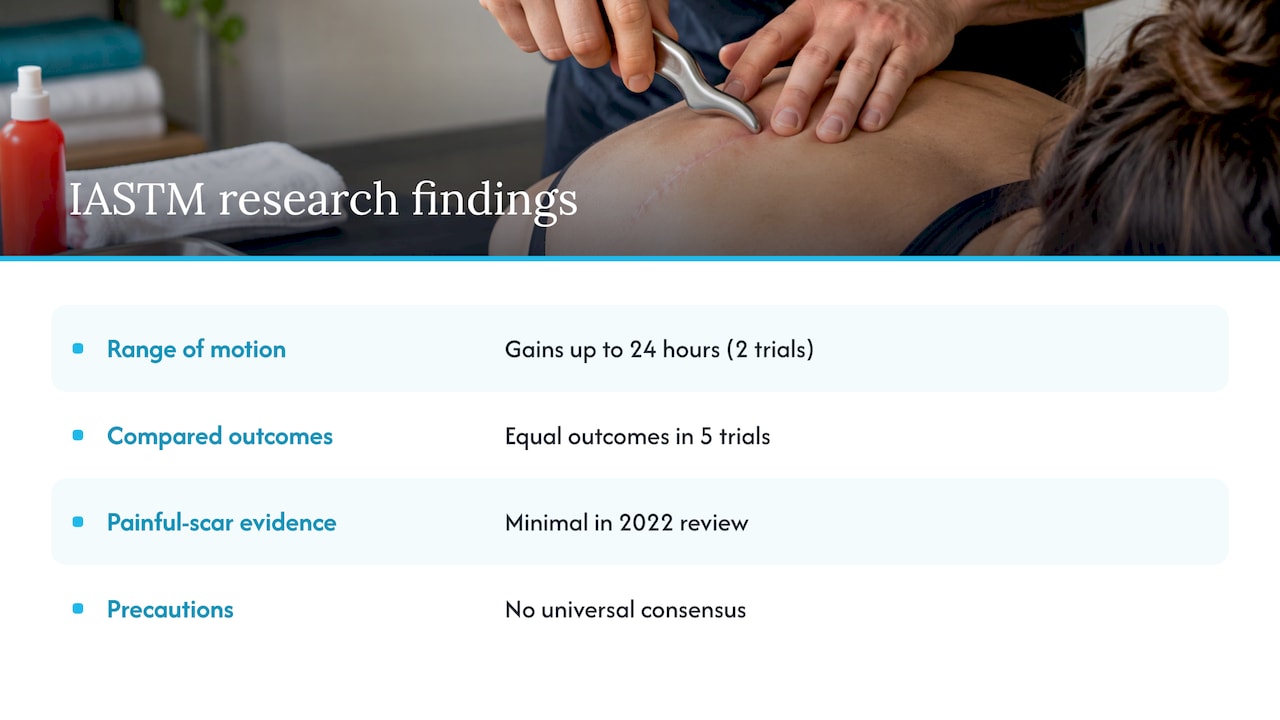
A 2016 systematic review of IASTM looked at randomized trials of the technique. It reported significant short-term gains in joint range of motion lasting up to 24 hours in two trials. That finding is useful for planning: a window of improved motion right after treatment is a good time to pair the manual work with active movement, so your body practices the new range.
The same review reported that, in five randomized trials comparing IASTM with a control or alternate intervention for musculoskeletal conditions, outcomes between groups were equal. What this tells a patient is practical: no single tool is the answer on its own. Results depend on matching the method to the tissue, the stage of healing and the person, and on following manual work with exercise. That is why we build plans around you rather than around one device.
Research on painful scars specifically is still developing. The 2022 review describes the physical therapy and rehabilitation evidence base for painful scars as minimal, and the manual approaches as used clinically. In plain terms, careful hands-on work, movement and patient feedback guide the process, and a good clinician adjusts as you respond.
One more point from the research: IASTM has no universal consensus on precautions. A commentary on IASTM clinical practice guidelines says few publications discuss recommended precautions and contraindications, and its suggestions draw on the existing IASTM and myofascial literature. That is a reason to choose a clinician who screens your history carefully, which the next section covers.
If you have low bone density, you may also be interested in red light therapy for bone health, a topic worth raising with your physician alongside any manual therapy plan.
Staying safe: who should tell us what first
Manual scar work is safest when your clinician knows your full history. The IASTM guideline commentary lists conditions that may be treated as precautions or contraindications depending on the individual: high pain sensitivity, acute inflammatory conditions, congestive heart disease or circulatory disorders, osteoporosis, cancer, pregnancy, diabetes, varicose veins and hypertension. That does not mean care is off the table. It means your plan, pressure and technique may change, and sometimes your medical doctor should weigh in first.
Before your first visit, gather this information:
- Surgery details: the date, the type of procedure and the name of your surgeon. If the incision is recent, ask your surgeon when manual work near it is appropriate.
- Skin status: tell us if the scar is open, draining, red, hot or newly swollen. Those signs call for your physician or surgeon, not for manual therapy.
- Medical conditions: heart or circulation problems, diabetes, osteoporosis, cancer history, varicose veins and high blood pressure.
- Medications: especially blood thinners, which affect how much pressure and which techniques are appropriate.
- Pregnancy: let us know at the outset. We also have pages on chiropractic care for pregnancy with details on how care is approached.
- Numbness, weakness or spreading pain: these symptoms need a proper evaluation to find the cause before any scar work.
Seek urgent medical care, not a chiropractic appointment, for fever with a wound, spreading redness, sudden swelling and pain in one calf, chest pain, or loss of bladder or bowel control.
What soreness after treatment is normal
Mild tenderness for a day or so after deeper soft tissue work is common. Light movement usually helps. If you train hard, plan lighter sessions for the treated area right after a visit; this guide on training through muscle soreness walks through adjusting a session by how your warm-up feels. Pain that is sharp, worsening, or accompanied by bruising that spreads should be reported to us right away so we can adjust the plan.
The Tx Room perspective
We see scar tissue problems most often in people who have already tried the usual routes. A runner with an old calf strain that never loosened. A parent whose cesarean scar pulls whenever they lift a toddler. An office worker with a shoulder that stiffened after an injury and never returned to full motion.
Our view is simple: scar tissue is a movement problem as much as a tissue problem. That is why we do not rely on one tool. The Fascial Distortion Model gives us a hands-on way to find and treat the specific distortion you point to. Myotherapy, dry needling, laser therapy and focused shockwave give us additional options when a case needs them. Chiropractic care keeps the joints around the area moving. Then rehab makes the change last.
We focus on cases that have not improved with standard medical or physical therapy approaches, and we build each plan around the person in front of us. We do not promise a number of visits before we have examined you, and we adjust pressure and technique as your tissue responds.
If an old scar is limiting what you do, hands-on care is a reasonable next step, and we would be glad to look at it with you.
Chris
Tools we use for soft tissue restrictions in Plano
Scar-related problems are rarely identical, so we choose from a range of services based on your exam. Here is how each fits.
| Approach | How it is used | Where to read more |
|---|---|---|
| Fascial Distortion Model | Hands-on technique guided by how you describe and point to the problem | Fascial Distortion Model |
| Myotherapy | Focused soft tissue work with a rehab mindset | Myotherapy benefits |
| Active Release Treatment | Hands-on tension combined with active movement | Active Release Treatment |
| Dry needling | Fine needles used in tight muscle areas as part of a plan | Dry needling |
| Deep tissue therapy laser | Laser applied to soft tissue areas | Deep tissue therapy laser |
| MyACT (focused shockwave) | Focused acoustic compression for myofascial tissue | MyACT focused shockwave |
Not every patient receives every service. Often, a first plan uses one or two hands-on methods plus movement work, and we add to it only if your response calls for it.
What a visit looks like
- History. We ask about the original injury or surgery, how long ago it happened, what movements bother you and what you have already tried.
- Movement and tissue exam. We watch how you move, test the joints above and below the scar, and palpate the area to find where tissue feels restricted or tender.
- Targeted treatment. Based on the exam, we start with the method that suits your tissue and your stage of healing, adjusting pressure as you give feedback.
- Re-test. We repeat the movement that bothered you to see what changed. This tells us whether the approach is working.
- Home plan. You leave with specific movements to do between visits, usually short enough to fit into a busy day.
Follow-up visits repeat the cycle with progress to the exercise. Some cases involve a few visits; others take longer, especially when the scar is old or the surrounding area has been compensating for years. We discuss what we find at the exam and set expectations then.
Doing your part between visits
What you do between appointments has a large influence on how well hands-on work holds.
- Keep the area moving. Gentle movement through the pain-free range is better than guarding the area.
- Follow the home program. A few minutes a day does more than one long session a week.
- Build up load gradually. Return to lifting, running or long hours at a desk in steps, not all at once.
- Watch your pattern. If a different joint starts to ache, tell us. It may be taking extra load from the restricted area.
- Do not self-treat aggressively. Digging at a scar with tools or high pressure at home can irritate tissue; the research notes excessive pressure may aggravate pain or disrupt healing. Ask us for a gentle technique you can use.
For related self-care guidance, our page on fascia pain self-care explains how long to try home measures before getting hands-on help. If your pain is in the upper back, see our page on shoulder blade pain relief.
Common situations we see
Old sprains and strains. A previous ankle, hamstring or calf injury that healed but never felt right. Treatment looks at the scarred tissue and at how the foot, knee and hip share load. Related problems like tendinitis sometimes appear in the same region.
Surgical scars. Once your surgeon has cleared you for manual therapy, work around the scar can address tightness, sensitivity and the movement changes that follow surgery.
Back and hip restrictions. Scar-related stiffness around the spine, hips or pelvis can add to back pain. See our page on back pain relief with chiropractic in Plano for how we approach it.
Posture-related patterns. When one area stays restricted, the body may build imbalances elsewhere, such as the patterns described in our lower cross syndrome rehab page.
Book an evaluation in Plano
If an old injury or a surgical scar is still limiting how you move, we can examine it, explain what we find and build a hands-on plan around your goals. We work with athletes and non-athletes, and we accept both self-pay and insurance. Start at The Tx Room to request a visit.
We publish no set price for these services online, so call or message the clinic for details on your first visit.
FAQ
Can a chiropractor break down scar tissue?
Chiropractors use manual soft tissue techniques, such as massage, soft tissue mobilization and IASTM, on scarred areas to improve how tissue moves and feels. Published reviews describe these as manual approaches used clinically in rehabilitation, and they work best alongside exercise. We assess your tissue first and set expectations at the exam.
How do you loosen old scar tissue?
Old scars usually respond to a combination of hands-on work, movement and progressive loading. The 2022 review of painful scar management groups care into passive modalities, manual therapies and supervised exercise. Your plan may use all three, with pressure adjusted to how your tissue responds.
Is scar tissue treatment painful?
You may feel pressure or a deep, sore sensation in a tender area, but treatment should stay within what you can tolerate and breathe through. Speak up if it becomes sharp. Research notes that excessive pressure may aggravate pain or disrupt healing, so we grade pressure to your feedback.
How soon after surgery can I have scar work?
That depends on your procedure and how the incision has healed. Ask your surgeon when manual therapy near the area is appropriate, and bring that guidance to your visit. We do not work on open, draining or newly inflamed wounds.
Can chiropractic care help with other conditions linked to old injuries?
Often, yes. Old restrictions can contribute to problems such as sciatica, plantar fasciitis, repetitive strain and posture issues, which is why our exam looks at the whole movement chain rather than only the sore spot.
Sources
- Diagnosis, Treatment, and Management of Painful Scar: A Narrative Review (2022)
- The efficacy of instrument assisted soft tissue mobilization: a systematic review (2016)
- Instrument assisted soft tissue mobilization: a commentary on clinical practice guidelines (2019)
- Red light therapy for arthritis and bone health
- Training with DOMS: lift, modify, or rest